Divaina.com, 03/05/2013
නිලන්ත මදුරාවල
රුපියල් හැත්තෑපන් ලක්ෂයකට පේරාදෙණිය විශ්වවිද්යාලයීය වෛද්ය උපාධිය ලබා ගැනීම සඳහා විශ්වවිද්යාල ප්රතිපාදන කොමිෂන් සභාව එවූ ශ්රී ලාංකික සිසුන් නව දෙනා පිළි නොගැනීමට එම වෛද්ය පීඨ මණ්ඩලය ඊයේ (2 වැනිදා) දහවල් තීරණය කළේය.
මෙම එක් සිසුවකුගෙන් වසරකට රුපියල් ලක්ෂ පහළොවක් (15 ක්) හෙවත් ඇමරිකානු ඩොලර් දොළොස්දහසක් අය කළ යුතු බව විශ්වවිද්යාල ප්රතිපාදන කොමිෂන් සභාව පේරාදෙණිය විශ්වවිද්යාලයට ලිතව දැනුම් දී ඇත.
මෙම සිසුන්ගේ පැමිණීමත් සමග උසස් පෙළ විභාගයෙන් සමත්ව වෛද්ය පීඨයට ඇතුළත්ව සිටින සිසුන් අතර ඊයේ දැඩි නොසන්සුන්තාවක් ඇති වී තිබිණි. පේරාදෙණිය වෛද්ය උපාධිය මෙලෙස මුදලට අලෙවි කිරීමේ ක්රියා මාර්ගයට විරෝධය පළ කරමින් සිසුහු ඊයේ දහවල් විශ්වවිද්යාල භූමියේදී සත්යග්රහයක ද නිරත වූහ.
වෛද්ය උපාධිය මුදලට ලබා ගැනීම සඳහා පැමිණි සිසුන් නවදෙනා වෛද්ය පීඨ සිසුන් ලෙස පිළිනොගැනීමට පීඨ මණ්ඩලය තීරණය කළේ සිසුන්ගේ සත්යග්රහ විරෝධතාවෙන් පසුවය. ප්රතිපාදන කොමිෂන් සභාව විසින් යවන ලද ශිෂ්ය නාමලේඛනයේ මුස්ලිම් හා දෙමළ සිසුහු දෙදෙනා බැගින් සිටිති.
විදේශයන්හි අධ්යාපනය ලැබූ මෙම ශ්රී ලාංකික සිසුන් වෛද්ය පීඨයට ඇතුළත් කළේ කැබිනට් මණ්ඩල තීරණයක් අනුව යෑයි මේ සම්බන්ධයෙන් "දිවයින" කළ විමසුමකට පිළිතුරු දුන් ප්රතිපාදන කොමිෂන් සභාවේ ජ්යෙෂ්ඨ නිලධාරියෙක් පැවසීය. මේ අයුරින් ශ්රී ජයවර්ධනපුර, රුහුණ, කැලණිය හා රජරට යන විශ්වවිද්යාලයන්හි වෛද්ය පීඨයන්ට ද සිසුන් ඇතුළත් කර සිටින බවත් හෙතෙම කීවේය.
විදේශයන්හි අධ්යාපනය ලබන ශ්රී ලාංකිකයන් රාජ්ය විශ්වවිද්යාලවලට ඇතුළත් කිරීම සඳහා පැවැති සියයට දශම පහක ප්රතිශතය මේ වන විට සියයට පහ දක්වා වැඩිකර ඇති බවත් මෙම සිසුන් ඇතුළත් කර සිටින්නේ ඒ අනුව බවත් එම නිලධාරියා ප්රකාශ කළේය.
මෙම සිසුන් තෝරා ගත්තේ ඒ ඒ වෛද්ය පීඨවල පීඨාධිපතිවරුන් බවද එම තෝරා ගැනීම් සඳහා ප්රතිපාදන කොමිෂන් සභාව සම්බන්ධ නොවූ බවද එම නිලධාරියා තවදුරටත් කියා සිටියේය. සිසුන් ඇතුළත් කිරීම නීත්යනුකූලව සිදුකර තිබෙන බවද පීඨ මණ්ඩලය, ඔවුන් ඇතුළත් කරන අවස්ථාවේ විරෝධයක් දක්වා නැති බවද එම නිලධාරියා සඳහන් කළේය.
එමෙන්ම කැබිනට් මණ්ඩලය ගත් තීරණයක් ක්රියාත්මක කිරීමට ඕනෑම ආයතනයක් බැඳී සිටින බවත් හෙතෙම ප්රකාශ කළේය.

Friday, May 3, 2013


Sleeping Left On May Day
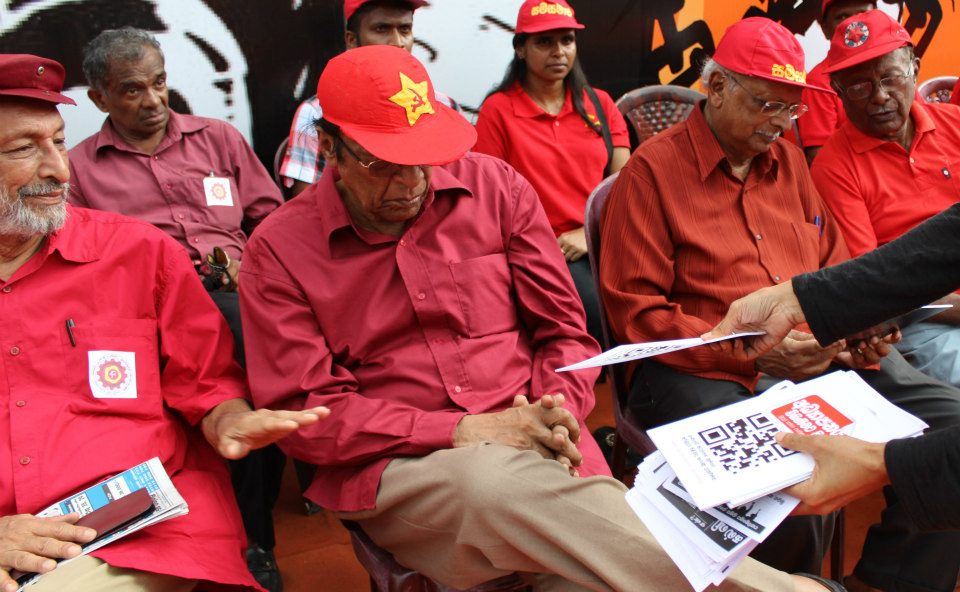
Vasudeva Nanayakkara, DEW Gunasekara and Tissa Vitarana at Socialist Alliance May Day stage – Photo by a member of FUTA
Islamic Culture And The Challenge Of Buddhist Fundamentalism
Dr. Liyanage Amarakeerthi
When I heard about the Boston explosions I had many hopes. First, I hoped that my teacher, who is at Harvard, was safe. Second, I hoped no one was killed. Third, I hoped there was no any Muslim connection to the explosion. Finally, I hoped Boston, one of my favourite American cities, liberal, leftwing, cosmopolitan and intellectually bent, was not disrupted by any fundamentalist attacks, internal or external.
I found out soon enough that my teacher was safe. Sadly, some people died, including an eight-year old boy- someone from my son’s generation. America has its own fundamentalists. When it goes to war, America (Washington) itself is fundamentalist. International terrorism is a real problem and all fundamentalists are party to that terrorism. America’s not-so-democratic acts in the past also keep following like the cart behind the oxen as it has in a Dhammapada verse. In Sri Lanka too we have to be mindful of our collective Karma.
My third hope was much more Sri Lankan than personal. In Sri Lanka, Bodu Bala Sena (‘the army of Buddhist power’) – the newest and crudest version of Sinhala nationalism- is up against Sri Lankan Muslims, claiming that they are invading the social, cultural, economic spheres, pushing aside the Sinhala majority. I do not know the factual position. But the rhetoric seems to suggest something much more dangerous than the facts (even if they are correct) ever could. Some of the BBS (or of the populace attracted to the organization) accusations are really absurd: some Muslim-owned clothing store (a chain of shops in fact) is selling an incredible female underwear that makes Sinhala women barren. The argument is that this shop chain is part of a Muslim conspiracy to reduce the Sinhala population in the country.

World Literature: A Reader (Routledge, 2013) Editors: Prof. Cesar Domingues et al
One of my friends from Scotland wanted to buy that particular underwear so that he can control the population growth in his country. But, according to the BBS, that underwear only upsets the workings of the relevant organs ofSinhala-Buddhistwomen! So, he did not buy it. Apart from these absurd claims, there is a real lack of understanding between the two communities for which the civil society of both communities is responsible. It is the lack of understanding that gives rise to these absurd urban myths, which are more political than factual. America too had them: McCarthyism was a result of that and McCarthyism is not totally gone.
I do not know what kinds of myths Muslim fundamentalists in Sri Lanka are propagating against Sinhala people. There must be some equally funny ones. Fundamentalisms are fun if no one believes them; but many do. Sinhala people certainly do: look at Facebook.
Anyway, I hoped that there was nothing Muslim about the Boston bombing because the Sinhala racist BBS who would have benefited by it. (The BBS leaders were to visit the US when the explosion occurred. There is an argument that the US is happy for the BBS because they are against Muslims: I hope the argument is wrong.) They would have claimed that their fight against Sri Lankan Muslims was right and based on facts. Yes. Islamic fundamentalism is much more global than Sinhala fundamentalism and we all have to be aware of that fact while being cognizant that US imperialism actually helps Islamic fundamentalism. Islamic civilization, however, is not all about fundamentalisms or parochialisms. It has a great history of mutual understanding and sharing. Amartaya Sen’s Argumentative Indian (2005) describes some aspects of it. According to Sen, there were some Muslim kings and queens who encouraged democratic debate and participated in them. They saw themselves as Indians not as Arabs.
Scholarly work
There are a significant number of scholarly works highlighting Islamic contributions to human civilization. The Ornament of the World, by Professor Maria Rosa Menocal shows how Christian, Jewish and Muslim communities contributed to the creation of European culture in medieval Spain. Living in Spain when writing this essay, I can see even today hues and flavours of Islam and Arabic culture in an ancient city like Santiago de Compostela, even though the beautiful city is markedly Catholic.
Many Indian scholarly works on Urdu and Hindi literature show how Islamic culture contributed to the making of modern literary cultures in South Asia. The new literary genres brought to South Asia by Islamic scholars and writers made our literary culture even richer. Ghazal would be a famous example. Professor Shamur Rahman Faruqui’s excellent book Early Urdu Literary Culture and History is one of those books I studied with one of the great teachers of mine: Professor Muhammad Umar Memon. When reading Faruqui’s book I always wondered why Sri Lankan Muslim scholars could not engage in such studies. I am still to see a systematic study of Sri Lankan Muslim literature. There may be things in Tamil, I am sure. But our Muslim scholars must present such studies in a way that deepens our inter-ethnic understanding. One aim of their scholarship must be to develop a dialogue with the Sinhala community. To say that is not a pro-majority argument but a cosmopolitan one.
Only my friend, a brilliant poet and scholar, Professor M. A. Nuhman, has made such an attempt worth noting. His recent interview with the Sinhala daily Janarala was a window to the heart of a moderate and liberal Muslim intellectual. We need more like him. (There are some books by Nilar N. Casim, but they are more journalistic than scholarly).
Creating new knowledge
Three days after the Boston bombs, Professor Cesar Dominquez, a rising star in the field of Comparative Literature in Europe, showed me his copy of a brand new book that Routledge has published this year: World Literature: A Reader. It is edited by Theo D’haen, Mada Rosendhal Thomson and Dominguez himself. This collection of essays is sure to enrich our knowledge of the globally-rooted human activity called ‘literary writing.’ But the first essay of the book immediately captured my attention. I borrowed the book right away because there was something in it I want to share with Sri Lankan readers as soon as possible in this age of Bodu Bala Sena.
The essay is an excerpt from a book written by a Spanish Jesuit scholar named Juan Andres and published between 1782 and 1799. Its translator, Cesar Dominguez and the editors, widen our knowledge on the concept of world literature by presenting it as the first chapter of the book. The origin of the concept of “world literature” in the West is often attributed to Goethe. This piece shows that the concept has somewhat older antecedents in Europe. Juan Andres has undertaken to write a multi-volume literary history in Italian under the title of On the Origin, Progress and the Present State of All Literature covering Persian, Indian, Chinese and Arabic literatures, in addition literature in European languages. During the author’s lifetime alone, the book has gone into many editions.
The book is significant in more than one way. One of the features I like to highlight in this short essay is Juan Andres’ unfailing acknowledgement of the contribution of non-European people to the making of world literature. He points out that modern European literature is indebted to Arabic literature, for the latter has enriched the former by “re-establishing the belles lettres” or artistic writing.
“The Arabs”, continues Andres, “with their translations and studies, partly increased Greek science and, via Spain, introduced the natural sciences into Europe. They also, by cultivating all the branches of the belles lettres, gave rise to both a new kind of poetry in our regions and improved our culture and our vernacular languages. Literature was, therefore, reborn in Europe.”
Observe the Jesuit-priest author’s generous words in appreciating Arabic (Islamic) contribution to modern world literature. He also praises Indian and Chinese literature in words that were difficult to find in those early days of “Orientalism”.
Understanding ourselves anew
We in Sri Lanka must understand anew our shared humanity and culture rather than falling into the traps of cultural purisms. In this, the Buddhist fundamentalism of Bodu Bala Sena is not going to help us, and, in fact, they are there to destroy our collective memory of commonality. The ideological fathers of this group are still to say a word about their uncultured progeny. Having heard savagely racist speeches the leaders of BBS made in Kandy it is a euphemism to call them ‘uncultured.’ The response to this group from moderate Muslims is far from appealing and convincing. I did not see any Muslim intellectuals saying anything, in Sinhala or English, asking both Sinhala and Muslim communities to understand their shared history and culture that go back many centuries.
Sinhala community has to realize that our Sinhalaness is a product of many cultural sharings and borrowings. If we were to give away supposedly Muslim elements in our food, so-called Sinhala cuisine will be devoid of some its great flavours and some subtle taste buds in our ‘Sinhala’ tongues will be dried up like fish without water.
People like Samuel Huntington have set up a trap for us in South Asia. Huntington was an ideologue of the American right and of American imperialism and his Clash of Civilizations is a programmatic text for American imperialism. The way he describes the world in it is too simple, flat and one-dimensional. Just remember the way he casts the world under monolithic identities. For example, India for him, for example, is Hindu. He ignores the fact that so-called Hindu India is a fine mixture of many cultures, differences and languages. For Huntington, Sri Lanka is just Buddhist: no wonder some Buddhist nationalists are big fans of this American rightwing ideologue.
Groups like BBS are too dangerous to ignore but too parochial to take seriously. While watching what they are doing, it is better for us all communities to understand our shared history, shared everyday life. The week Bodu Bala Sena came to Kandy I started my lectures on Comparative Literature at Peradeniya, and my first reading assignment was three stories by Sri Lankan Muslim writers from the collection Asalawesi Api, edited by Professors Carmen Wickramagamage and M. A. Nuhman. In those stories, the feelings of attachment to certain villages, soil, farmland and so on in those Muslim villagers were very similar to ours. Those students who read them rejoiced in the discovery of commonness found in them.
Yet again, I heard there were so many university students at the BBS rally, cheering the racist speeches. It is very easy to instigate communal feelings and it does not take a whole lot of learning to do so. To understand how communities collectively create cultures and civilizations, one needs some effort and learning.
We can either take up that challenge or sadly observe a country that has a great cosmopolitan history and culture disintegrate into fragments from which we will never find our cultural or human wholeness and wholesomeness.
When I end this essay, I wish I could sit with the Jesuit priest Juan Andres to have a cup of tea (or coffee if he prefers,) who wanted to write a literary history in which he was to pay tribute to every human community that contributed to making of notion of literature: one of the greatest human creations. I will never have that sense of belonging to the likes of the BBS leaders, in spite of my Buddhist upbringing, even if tea or coffee is replaced with a bottle of arrack! Arrack is one of those Sri Lankan cultural products, Cumaratunga Munidasa, a great defender of arrack industry in the country, would have agreed, which is too good to share with racists!
*Writer is a senior lecturer at department of Sinhala, University of Peradeniya, and visiting scholar at university of Santiago, Spain
Thursday, May 2, 2013
FUTA May Day Media Statement - 2013
Download FUTA May Day Media Statement 2013
The 1st of May is an important day for Trade Unions. It is a day when the rights of the working people are celebrated and where the battles that were fought to protect the rights and dignity of working people all over the world are celebrated and remembered.
Education is of vital importance for the working people. In Sri Lanka, the free education system enabled many generations of working people to seek a better future for their children. The Federation of University Teachers’ Association therefore, decided to use this occasion to generate awareness of the threats to free education faced by the people of Sri Lanka today. We are aware of the fact that the gradual shift of the financial burden of education on parents and families due to the government’s systematic withdrawal from the state education system has serious financial consequences of working people. We believe it is extremely important that the politically conscious working population of Sri Lanka, who will be celebrating May Day today are also made fully aware of the crisis in the education sector.
The campaign launched last year by the FUTA to demand that the government allocate 6% of GDP for Education and Save State Education was re-launched on the 2nd of April this year. The FUTA’s awareness raising campaign on May Day this year is one of the several events that we have planned in taking this campaign forward.
We are confident that the working people of this country will hear our message and join us in our campaign. We hope the government as well as all political parties heed the voice of the people and take all steps to ensure that the legacy of free education in this country will not be destroyed.
Save State Education!
Allocate 6% of GDP for Education!
Let us join hands to prevent the commodification of Education!
Saturday, April 27, 2013
The neoliberal assault on academia
Aljazeera, 25 Apr 2013 08:30
By Tarak Barkawi
The neoliberal sacking of the universities runs much deeper than tuition hikes and budget cuts, notes Barkawi.
By Tarak Barkawi
The neoliberal sacking of the universities runs much deeper than tuition hikes and budget cuts, notes Barkawi.
Students are increasingly unwilling to take on massive debt for jobs they have little confidence of getting [EPA]
Much of the coverage has focused on the sub-poverty wages of adjunct faculty, their lack of job security and the growing legions of unemployed and under-employed PhDs. Elsewhere, the focus has been on web-based learning and the massive open online courses (MOOCs), with some commentators celebrating and others lamenting their arrival.
The two developments are not unrelated. Harvard recently asked its alumni to volunteer their time as "online mentors" and "discussion group managers" for an online course. Fewer professors and fewer qualified - or even paid - teaching assistants will be required in higher education's New Order.
Lost amid the fetishisation of information technology and the pathos of the struggle over proper working conditions for adjunct faculty is the deeper crisis of the academic profession occasioned by neoliberalism. This crisis is connected to the economics of higher education but it is not primarily about that.
The neoliberal sacking of the universities runs much deeper than tuition fee hikes and budget cuts.
Thatcherite budget-cutting exercise
The professions are in part defined by the fact that they are self-governing and self-regulating. For many years now, the professoriate has not only been ceding power to a neoliberal managerial class, but has in many cases been actively collaborating with it.
As a dose of shock capitalism, the 2008 financial crisis accelerated processes already well underway. In successive waves, the crisis has hit each pillar of the American university system. The initial stock market crash blasted the endowments of the prestige private universities. Before long, neoliberal ideologues and their disastrous austerity policies undermined state and eventually federal funding for universities and their research.
Tuition soared and students turned even more to debt financing. Now that bubble is bursting and hitting all the institutions of higher education that depend on tuition. Students are increasingly unwilling to take on massive debt for jobs they have little confidence of getting.
The upshot is to soften the resistance of faculty to change, in part by making people fear for their jobs but mostly by creating a generalised sense of crisis. It becomes all the easier for some academic "leaders" to be drawn up into the recurrent task of "reinventing" the university.
Here is the intersection with neoliberal management culture. Neoliberal managers thrive not by bringing in new resources - since austerity is always the order of the day - but by constantly rearranging the deck chairs. Each manager seeks to reorganise and restructure in order to leave his or her mark. They depart for the next lucrative job before the ship goes under.
One consequence is the mania for mergers of departments and faculties in the US and the UK. In both the university and corporate world, mergers are not only demoralising for staff, but they also break up solidarities and destroy traditions and make staff much more amenable to control from above.
Such projects have little to do with academic excellence or even purposes, and often are self-defeating as the managers and the quislings among the professoriate who assist them have little idea what they are doing.
One of the only things the University of Birmingham was ever known for in the wider world was its Centre for Contemporary Cultural Studies. In 2002, the Centre was shut down by fiat in an act of vandalism described as "restructuring". The justification given for this was yet another neoliberal exercise then known as the Research Assessment Exercise, or RAE.
US universities to consider positive discrimination |
In neoliberal speak, this may sound very sensible. But imagine what happens to, say, physics and biology students, when, as the University of Exeter did, the chemistry department is shut down. Who will teach them chemistry?
More to the point, how do you judge which is "best"? For this, the RAE needed the willing and active collaboration of the professoriate.
When I first held a UK academic post in the relatively early days of the RAE in the late 1990s, academics talked about it as if it were just some form they had to fill out, an annoying bureaucratic exercise that would not really affect us. Others, academic "leaders", saw it as an opportunity to do down their colleagues in other universities and channel funds to their own departments.
Neoliberal assault on the universities
In this way, the professors themselves helped to administer and legitimate a Thatcherite budget-cutting exercise. Worse, they participated in what they know to be a fiction: that you can rank scholarly research like you can restaurants or hotels so as to determine which departments have the "best" faculty.
Little more than a decade later - and now known as the Research Excellence Framework (REF) - this five-yearly exercise completely dominates UK academic life. It determines hiring patterns, career progression, and status and duties within departments. It organises the research projects of individual scholars so as to meet arbitrary deadlines. It has created space for a whole class of paid consultants who rank scholarship and assist in putting together REF returns.
UK academics regularly talk about each other's work in terms of whether this or that book or article is "three star" or "four star". Again, for those attuned to neoliberal ways of thinking, this may appear natural. But remember that the entire point of university research is conversation and contestation over what is true and right. In the natural sciences, as in the social sciences and humanities, one person's truth is another person's tosh, and valid knowledge emerges from the clash of many different perspectives.
Somehow, UK professors have become intimately bound up in administering and legitimating a government-run exercise that now shapes more of university life than they themselves do. They have actively ceded their power.
US faculty need to keep this travesty in mind.
Something as apparently innocuous as an accreditation agency demanding that syllabi be written in a particular format, or majors justified in a particular way, can wind up empowering university management to intimately regulate teaching. A meaningless buzzword in the mouth of a dean, such as "new majority student", might in practice help legitimate the hiring of less qualified faculty. After all, if "teacher ownership of content" is old fashioned, why do you need to hire a professor who can create his or her own course?
The bottom line of the neoliberal assault on the universities is the increasing power of management and the undermining of faculty self-governance. The real story behind MOOCs may be the ways in which they assist management restructuring efforts of core university practices, under the smiley-faced banner of "open access" and assisted in some cases by their "superstar", camera-ready professors.
Meanwhile, all those adjunct faculty are far more subject to managerial control and regulation than are tenured professors. Aside from their low cost, that is one of the principal reasons why they are so attractive to university managers.
Tarak Barkawi is Associate Professor in the Department of Politics, New School for Social Research.
The views expressed in this article are the author's own and do not necessarily reflect Al Jazeera's editorial policy.
 |
No Grade One admissions in 275 schools
Ceylon Today, Saturday, 27 Apr 2013
Not a single student has been admitted to the grade one classes of 275 schools in the country, Minister of Education, Bandula Gunawardena told Parliament yesterday.
He said there are 2,123 schools in the country to which the grade one admissions were less than ten students.
The minister said there are 123 schools, which had only one Grade One admission, 143 schools, which had admitted only two students, 181 schools, which admitted three students, 210 schools, which admitted only four students and 223 schools that received only five Grade One admissions.
The minister said there are 963 schools which had admitted six to nine students for the Grade One classes, and added that the situation was a result of the attitude of parents to get their children admitted to popular schools in the cities. It had also resulted in a poor student-teacher ratio of five to one in the rural schools, the minister said. During the last seven months, 36 schools in rural areas had been closed down owing to there being less number of students.
The minister said this in response to a query raised by Kurunegala District UNP MP Akila Viraj Kariyawasam.
Not a single student has been admitted to the grade one classes of 275 schools in the country, Minister of Education, Bandula Gunawardena told Parliament yesterday.
He said there are 2,123 schools in the country to which the grade one admissions were less than ten students.
The minister said there are 123 schools, which had only one Grade One admission, 143 schools, which had admitted only two students, 181 schools, which admitted three students, 210 schools, which admitted only four students and 223 schools that received only five Grade One admissions.
The minister said there are 963 schools which had admitted six to nine students for the Grade One classes, and added that the situation was a result of the attitude of parents to get their children admitted to popular schools in the cities. It had also resulted in a poor student-teacher ratio of five to one in the rural schools, the minister said. During the last seven months, 36 schools in rural areas had been closed down owing to there being less number of students.
The minister said this in response to a query raised by Kurunegala District UNP MP Akila Viraj Kariyawasam.
Tiny state’s disaster belies big lessons
The Island, April 1, 2013, 12:00 pm
by Jonathan Eyal
A racially diverse island ruled by the British gets its independence during the 1960s, despite the doubtful noises of its neighbours, who believe that it could never be viable. The newly created island-state possesses neither raw materials nor much land, but still develops a prosperous economy by diversifying into banking, commercial services, shipping and tourism. Need further help in guessing the name of that country?
Perhaps you do, for this is the story of Cyprus, a nation which, in return for avoiding bankruptcy, has now agreed to the destruction of its banking system, accounting for about 10 per cent of national wealth. And although no two countries are the same, how Cyprus ended up in this tragic situation and how this squalid, miserable episode could have been averted remains a tale of crucial importance to all small and medium-sized countries, including Singapore.
The Cypriots may detest being reminded of this, but the fact remains that when they recently came cap-in-hand to Europe, they attracted no sympathy.
For early on in its independent existence, Cyprus flunked its most essential national test: that of maintaining harmony between the majority ethnic Greeks and the minority Turkish population. The result was a 1974 coup d’etat fomented by neighbouring Greece, followed by a military intervention from neighbouring Turkey which divided the island along sectarian lines.
Since then, the Cypriot Greeks have held the rest of Europe to ransom in their obsession to regain their lost land, preferably without re-absorbing their Turkish minority. The Greek-dominated Cypriot government rejected a 2004 plan sponsored by then United Nations Secretary General Kofi Annan to reunite the island. And it blocked every effort to forge an urgently needed strategic relationship between Europe and Turkey. Cyprus’ behaviour exasperated European Union governments for decades. Those Cypriots who now bemoan the lack of solidarity from Europe are well-advised to recall that their government offered little solidarity to the rest of the continent.
The EU not blameless
Still, none of this should absolve EU leaders from their own responsibility. For the path that led to Cyprus’ current crisis - big banks bereft of money, a government in disarray and citizens filled with angry despair - goes back to October 2011, when the EU finance ministers, those supposed guardians of financial discipline, decided at a secretive meeting in the dead of night to slash the value of Greek bonds in order to reduce Greece’s debt.
That "haircut" was bound to affect Cypriot banks, which held large amounts of Greek bonds. As Mr Charles Dallara, the lead representative for the banking industry at that time now admits, it was "very clear that the effect of the Greek deal on Cypriot banks would be severe".
"But the tendency in Brussels is to let these things drift, so nothing was done," he explains.
In fact, EU governments did worse than that: They turned a blind eye to the subsequent cover-up. Repeated health checks by the European Banking Authority before the Cyprus crisis erupted revealed significant concerns about banks in Spain, Greece or Austria but not a single one in Cyprus, despite the fact that as early as January last year the European Central Bank was providing "emergency loans" worth 430 million euros (US$551 million) to the Laiki Bank whose recent collapse pulled down the entire Cypriot economy. The idea that, somehow, Europe was surprised by Cyprus’ impending bankruptcy should be dismissed for what it is: patent nonsense.
And equally nonsensical is the argument that Cyprus had to suffer because its banks shielded illicit money from Russia. The really big Russian oligarchs - those who roll billions between their diamond-ringed fingers - have had no trouble buying football clubs in Britain or yachts and palaces on the French Riviera. The top oligarchs were also invited to sit on the boards of German oil and gas companies and, perhaps more enjoyably, attend the "bunga bunga" parties of Silvio Berlusconi, Italy’s merry-making former prime minister. Cyprus’ "sin" was not that it attracted doubtful Russian money but that it served as home to the cash of the small fry rather than the big fish, people who could be ignored and whose deposits could be wiped out.
German morality theatre
But the real explanation for the almost obsessive desire to punish Cyprus is that Germany, which acts as Europe’s ultimate bankroller, increasingly treats the euro currency crisis as a religious morality play between the supposedly serious nations of northern Europe who work hard and save for a rainy day, and the allegedly flippant, lazy countries of southern Europe who live on borrowed cash. So, no money is advanced unless the recipients are made to suffer penance and flagellation in public, and in the most humiliating circumstances.
Underlining this morality play is also a prevailing sense of hatred about global banking centres. This is partly due to sheer envy: Paris and Frankfurt tried to become such banking centres but, since both failed, the French and the German governments like to dismiss other bank centres as mere "tax havens", supposed dens of iniquity.
The hatred of banking centres is also buttressed by the prevailing mood among ordinary Europeans, who increasingly want banks to act as just glorified safekeeping vaults, safeguarding the hard-earned pension savings of old ladies and occasionally lending to family-owned businesses, preferably at zero interest rates and without taking any risk.
European leaders know that’s just primitive economics, and that some famously conservative banks can be just as reckless. That, after all, was the experience of Japan’s banks during the 1980s, when they financed one of the biggest property bubbles in modern history. Still, few European politicians are prepared to contradict their public on this score, so both the French and German finance ministers took great pleasure in dismissing Cyprus as a "casino economy". It was an underhand, unnecessarily offensive remark, but one which presumably played well with voters back home.
The result was not a bailout, but utter destruction. Cyprus’ debt will rise to 120 per cent of its national wealth. The country has just lost its core banking industry and has nothing to replace it with: It cannot hope to claw its way back to viability with a tourist boom because the euro currency has made it shockingly expensive. But it cannot leave the euro either, because nobody would prop it up. Ultimately, Cyprus was crucified because it was small: Its fate did not matter, so European leaders enjoyed kicking it about.
Prudent governance needed
But, far from providing an ominous warning about the inherent vulnerability of all small nations, Cyprus can offer them a salutary, constructive lesson.
The fact that Cyprus had a banking sector eight times bigger than the national economy should not be viewed as a source of weakness: Switzerland thrives for over a century on higher multiples than that, as does Luxembourg where bank assets are 22.5 times the size of the tiny state’s economy. What may be required, however, is to improve the capital ratios of the banks, to increase the cushions they have if some of their investments turn sour. Top-notch banking supervision is also a must. But none of this suggests that a banking centre cannot remain much bigger than the country in which it is located.
Furthermore, a nation can compensate for its small size through good governance, harmonious ethnic relations at home, the avoidance of disputes with neighbours and the cultivation of a positive image as a stakeholder in the global community.
Small nations may also need larger-than-usual currency reserves, and should also retain some mystery about the true value of their national financial assets, if only in order to keep others guessing about the muscle they can muster in times of need. For, as Cyprus’ recent experience illustrates, nobody will be willing to pick them up should they stumble. And quite a few would take great pleasure in inflicting pain, particularly if the nation which finds itself in need relies on banking services for its economic well-being.
"Better die on your feet than live on your knees," one defiant placard among the throngs of protesters in Nicosia, the Cypriot capital, read last week. Sadly, that’s no longer an option for the Cypriots, who are already on their knees and may not survive the economic ordeal either.
Yet there’s no reason other nations should ever repeat Cyprus’ sad experience.
(The Strait Times/ANN)
by Jonathan Eyal
A racially diverse island ruled by the British gets its independence during the 1960s, despite the doubtful noises of its neighbours, who believe that it could never be viable. The newly created island-state possesses neither raw materials nor much land, but still develops a prosperous economy by diversifying into banking, commercial services, shipping and tourism. Need further help in guessing the name of that country?
Perhaps you do, for this is the story of Cyprus, a nation which, in return for avoiding bankruptcy, has now agreed to the destruction of its banking system, accounting for about 10 per cent of national wealth. And although no two countries are the same, how Cyprus ended up in this tragic situation and how this squalid, miserable episode could have been averted remains a tale of crucial importance to all small and medium-sized countries, including Singapore.
The Cypriots may detest being reminded of this, but the fact remains that when they recently came cap-in-hand to Europe, they attracted no sympathy.
For early on in its independent existence, Cyprus flunked its most essential national test: that of maintaining harmony between the majority ethnic Greeks and the minority Turkish population. The result was a 1974 coup d’etat fomented by neighbouring Greece, followed by a military intervention from neighbouring Turkey which divided the island along sectarian lines.
Since then, the Cypriot Greeks have held the rest of Europe to ransom in their obsession to regain their lost land, preferably without re-absorbing their Turkish minority. The Greek-dominated Cypriot government rejected a 2004 plan sponsored by then United Nations Secretary General Kofi Annan to reunite the island. And it blocked every effort to forge an urgently needed strategic relationship between Europe and Turkey. Cyprus’ behaviour exasperated European Union governments for decades. Those Cypriots who now bemoan the lack of solidarity from Europe are well-advised to recall that their government offered little solidarity to the rest of the continent.
The EU not blameless
Still, none of this should absolve EU leaders from their own responsibility. For the path that led to Cyprus’ current crisis - big banks bereft of money, a government in disarray and citizens filled with angry despair - goes back to October 2011, when the EU finance ministers, those supposed guardians of financial discipline, decided at a secretive meeting in the dead of night to slash the value of Greek bonds in order to reduce Greece’s debt.
That "haircut" was bound to affect Cypriot banks, which held large amounts of Greek bonds. As Mr Charles Dallara, the lead representative for the banking industry at that time now admits, it was "very clear that the effect of the Greek deal on Cypriot banks would be severe".
"But the tendency in Brussels is to let these things drift, so nothing was done," he explains.
In fact, EU governments did worse than that: They turned a blind eye to the subsequent cover-up. Repeated health checks by the European Banking Authority before the Cyprus crisis erupted revealed significant concerns about banks in Spain, Greece or Austria but not a single one in Cyprus, despite the fact that as early as January last year the European Central Bank was providing "emergency loans" worth 430 million euros (US$551 million) to the Laiki Bank whose recent collapse pulled down the entire Cypriot economy. The idea that, somehow, Europe was surprised by Cyprus’ impending bankruptcy should be dismissed for what it is: patent nonsense.
And equally nonsensical is the argument that Cyprus had to suffer because its banks shielded illicit money from Russia. The really big Russian oligarchs - those who roll billions between their diamond-ringed fingers - have had no trouble buying football clubs in Britain or yachts and palaces on the French Riviera. The top oligarchs were also invited to sit on the boards of German oil and gas companies and, perhaps more enjoyably, attend the "bunga bunga" parties of Silvio Berlusconi, Italy’s merry-making former prime minister. Cyprus’ "sin" was not that it attracted doubtful Russian money but that it served as home to the cash of the small fry rather than the big fish, people who could be ignored and whose deposits could be wiped out.
German morality theatre
But the real explanation for the almost obsessive desire to punish Cyprus is that Germany, which acts as Europe’s ultimate bankroller, increasingly treats the euro currency crisis as a religious morality play between the supposedly serious nations of northern Europe who work hard and save for a rainy day, and the allegedly flippant, lazy countries of southern Europe who live on borrowed cash. So, no money is advanced unless the recipients are made to suffer penance and flagellation in public, and in the most humiliating circumstances.
Underlining this morality play is also a prevailing sense of hatred about global banking centres. This is partly due to sheer envy: Paris and Frankfurt tried to become such banking centres but, since both failed, the French and the German governments like to dismiss other bank centres as mere "tax havens", supposed dens of iniquity.
The hatred of banking centres is also buttressed by the prevailing mood among ordinary Europeans, who increasingly want banks to act as just glorified safekeeping vaults, safeguarding the hard-earned pension savings of old ladies and occasionally lending to family-owned businesses, preferably at zero interest rates and without taking any risk.
European leaders know that’s just primitive economics, and that some famously conservative banks can be just as reckless. That, after all, was the experience of Japan’s banks during the 1980s, when they financed one of the biggest property bubbles in modern history. Still, few European politicians are prepared to contradict their public on this score, so both the French and German finance ministers took great pleasure in dismissing Cyprus as a "casino economy". It was an underhand, unnecessarily offensive remark, but one which presumably played well with voters back home.
The result was not a bailout, but utter destruction. Cyprus’ debt will rise to 120 per cent of its national wealth. The country has just lost its core banking industry and has nothing to replace it with: It cannot hope to claw its way back to viability with a tourist boom because the euro currency has made it shockingly expensive. But it cannot leave the euro either, because nobody would prop it up. Ultimately, Cyprus was crucified because it was small: Its fate did not matter, so European leaders enjoyed kicking it about.
Prudent governance needed
But, far from providing an ominous warning about the inherent vulnerability of all small nations, Cyprus can offer them a salutary, constructive lesson.
The fact that Cyprus had a banking sector eight times bigger than the national economy should not be viewed as a source of weakness: Switzerland thrives for over a century on higher multiples than that, as does Luxembourg where bank assets are 22.5 times the size of the tiny state’s economy. What may be required, however, is to improve the capital ratios of the banks, to increase the cushions they have if some of their investments turn sour. Top-notch banking supervision is also a must. But none of this suggests that a banking centre cannot remain much bigger than the country in which it is located.
Furthermore, a nation can compensate for its small size through good governance, harmonious ethnic relations at home, the avoidance of disputes with neighbours and the cultivation of a positive image as a stakeholder in the global community.
Small nations may also need larger-than-usual currency reserves, and should also retain some mystery about the true value of their national financial assets, if only in order to keep others guessing about the muscle they can muster in times of need. For, as Cyprus’ recent experience illustrates, nobody will be willing to pick them up should they stumble. And quite a few would take great pleasure in inflicting pain, particularly if the nation which finds itself in need relies on banking services for its economic well-being.
"Better die on your feet than live on your knees," one defiant placard among the throngs of protesters in Nicosia, the Cypriot capital, read last week. Sadly, that’s no longer an option for the Cypriots, who are already on their knees and may not survive the economic ordeal either.
Yet there’s no reason other nations should ever repeat Cyprus’ sad experience.
(The Strait Times/ANN)
Tuesday, April 2, 2013


Tuesday, March 26, 2013
FUTA Media Release on the ban imposed on the Student Unions at the Sabaragamuwa University
Download pdf - English version
Download pdf - Sinhala version
22-03-2013, FUTA
The Federation of University Teachers’ Associations (FUTA) is deeply concerned about the situation that has been created by the ban
imposed on student unions at the Sabaragamuwa University of Sri Lanka by its higher authorities. FUTA considers this move as a grave violation of the democratic rights of students and a provocative action that could produce extremely dangerous consequences. FUTA notes with concern similar efforts to suppress lawful student union activities in other universities as well as attacks on student union leaders that have been reported recently.
The right to form student unions is a democratic right recognized by the Universities Act of 1978 and they have a significant role to play in ensuring the normal and healthy functioning of the student community. On one hand they function as a coordinating bridge
between the university administration and the student community and, on the other hand, they provide practical understanding and training to the student community on their social responsibilities. There is no doubt that there are instances where certain behaviors of these student bodies appear to be problematic and unacceptable. However, the university administration and the academic community must have an intelligent and mature approach to deal with such situations. Unfortunately, the politicization of the university administration has meant that they have lost any moral authority to take a principled, responsible stand with students.
One of the fundamental problems faced by the current university system is that senior university administrators view their primary task as pleasing the higher echelon of the state political authority. This is because they have acquired these positions not because they are qualified for these positions but because they have the backing of these politicians and the latter is convinced that they can manipulate the former. Under these circumstances university administrators do not have the integrity or character to directly confront the student community with any degree of moral authority. Therefore, the only alternative available when the students behave in a manner that displeases them is to unleash repressive measures on student activities. Students are viewed as enemies to be brought under control even by unlawful means.
The situation in the Sabaragamuwa University which has culminated in the ban imposed on Student Unions is an ideal example of this situation. FUTA does not consider such attitudes and measures as challenges faced only by the student community. FUTA is of the view that such measures are logical outcomes of the appointments of political loyalists to the University Grants Commission, Vice Chancellor positions of universities and other high posts in the university administration affecting the entire university
system including the academic and non academic community. The heart of the problem lies in the issue of university autonomy that the FUTA has been consistently highlighting recently. This is also why FUTA recently raised concerns with regard to the appointment of the Vice- Chancellor of the University of Colombo. Therefore, the FUTA reiterates the need to intervene actively and effectively to defend university autonomy and resist political interference in order to rectify this situation as an issue not merely relevant to the student community but to the entire university system. At the same time FUTA urges the administration of the Sabaragamuwa University to lift the ban on Student Unions and to initiate a fruitful dialogue with the student community.
Nirmal Ranjith Dewasiri
President/FUTA
Download pdf - Sinhala version
22-03-2013, FUTA
The Federation of University Teachers’ Associations (FUTA) is deeply concerned about the situation that has been created by the ban
imposed on student unions at the Sabaragamuwa University of Sri Lanka by its higher authorities. FUTA considers this move as a grave violation of the democratic rights of students and a provocative action that could produce extremely dangerous consequences. FUTA notes with concern similar efforts to suppress lawful student union activities in other universities as well as attacks on student union leaders that have been reported recently.
The right to form student unions is a democratic right recognized by the Universities Act of 1978 and they have a significant role to play in ensuring the normal and healthy functioning of the student community. On one hand they function as a coordinating bridge
between the university administration and the student community and, on the other hand, they provide practical understanding and training to the student community on their social responsibilities. There is no doubt that there are instances where certain behaviors of these student bodies appear to be problematic and unacceptable. However, the university administration and the academic community must have an intelligent and mature approach to deal with such situations. Unfortunately, the politicization of the university administration has meant that they have lost any moral authority to take a principled, responsible stand with students.
One of the fundamental problems faced by the current university system is that senior university administrators view their primary task as pleasing the higher echelon of the state political authority. This is because they have acquired these positions not because they are qualified for these positions but because they have the backing of these politicians and the latter is convinced that they can manipulate the former. Under these circumstances university administrators do not have the integrity or character to directly confront the student community with any degree of moral authority. Therefore, the only alternative available when the students behave in a manner that displeases them is to unleash repressive measures on student activities. Students are viewed as enemies to be brought under control even by unlawful means.
The situation in the Sabaragamuwa University which has culminated in the ban imposed on Student Unions is an ideal example of this situation. FUTA does not consider such attitudes and measures as challenges faced only by the student community. FUTA is of the view that such measures are logical outcomes of the appointments of political loyalists to the University Grants Commission, Vice Chancellor positions of universities and other high posts in the university administration affecting the entire university
system including the academic and non academic community. The heart of the problem lies in the issue of university autonomy that the FUTA has been consistently highlighting recently. This is also why FUTA recently raised concerns with regard to the appointment of the Vice- Chancellor of the University of Colombo. Therefore, the FUTA reiterates the need to intervene actively and effectively to defend university autonomy and resist political interference in order to rectify this situation as an issue not merely relevant to the student community but to the entire university system. At the same time FUTA urges the administration of the Sabaragamuwa University to lift the ban on Student Unions and to initiate a fruitful dialogue with the student community.
Nirmal Ranjith Dewasiri
President/FUTA
Sunday, March 24, 2013
The State of the Free Education System in Sri Lanka: Confessions of a Disgruntled Student
by Elijah Hoole, 27/03/2013
(A slightly modified version of this article also appeared in Ground views and the Colombo Telegraph)
I am one of the 243,876 lucky students who sat for the Advanced Level Examinations in 2011. It has been almost one-and-a-half-years since then, and I received my university registration form only yesterday (6 – 4 – 2012). I was privileged enough to receive A/L results four times in the space of ten months. For this, I am eternally indebted to the Examinations Department. The possibilities for further delay, once I start university are endless: the FUTA might decide to call for another trade union action; minor-staff may decide their wages are insufficient; fellow students may decide to oppose private universities by boycotting classes; and so on. The thought of how old I will be when I graduate is not entertaining.
Grand Promises and Disconcerting Realities
All state school textbooks carry an excerpt from a speech made by President Rajapaksa in 2010:
“Beloved Sons and Daughters, Many countries that lagged behind us at the time we gained independence have now passed us and gone far ahead. But, we must not be prepared to copy those countries or work according to the development models of those nations. Similarly, there is no purpose in continuing to lament about our lost heritage. What we shall do instead is to surpass them and reach a stage of overall development they have not reached, and show new paths and possibilities to the world. Dear Sons and Daughters, we are now engaged in building your future!”
Our country’s education standard has been very bad for long. One must, however, be conscious of the distinction between ‘standard’ and ‘system’. Under this regime the education system, too, is fast decaying.
A cursory glance at the record of the organs of the education system – relevant ministries, the University Grants Commission, the Examinations Department etc. – over the past few years would suffice to understand how appalling the situation is. In 2008, GCE Ordinary Level students were made to redo Part II of the mathematics paper, because the first paper was declared unfair. The problems related to the 2011 Advanced Level Examinations are well known; students were so confused that over a hundred thousand students applied for re-scrutiny (this costs Rs 750). In September last year, Ceylon Teachers Services Union criticized the Examinations Department for proceeding to evaluate Grade 5 Scholarship examination papers, without conducting proper investigations into alleged wrongdoings. Later last year, O/L science questions were leaked, and as a remedy all the students were freely awarded nineteen points (out of a hundred). Then there is also the controversy surrounding the Law College Entrance Examination. Add to these the numerous trade union actions led by teachers unions, shortage of teachers in schools and universities, occasional closure of universities, delays in releasing results and rampant corruption we have an unprecedented mess in the system .
The worst part about the whole story is that relevant authorities are undisturbed by this colossal deterioration. In fact, they maintain that things are just fine.
The Minister of Education and the Minister of Higher Education are operating without any vision or long term strategy. This was evident when Bandula Gunawardena recently debunked the ex-Chief Justice’s verdict on the Z-score fiasco. When asked why he accepted the ruling at the time it was issued, the Minister replied, ‘I did not want to end up in prison for contempt of court’. S B Dissanayake who spoke to the awaiting students, back in January, during the University Students’ Leadership Training is said to have evaded the most important question of when university classes would commence. Instead, he chose to slam the JVP and the remaining fragments of the LTTE for allegedly disturbing academic activities.
None of our universities feature in any university ranking of repute. Fortunes of once great universities like the University of Peradeniya are on the wane. Little ‘new’ knowledge is being produced as a result of limited funding for research.
Poor quality uniform material has been distributed, the treasurer of the Ceylon Teachers’ Union (CTU), Nishantha Deshapriya, charged on the 23rd of January. He claimed that children have been given sub-standard, transparent material to stitch uniforms with. Some students have found the length of the material short, and inadequate to tailor a complete uniform.
Each new day a new controversy surrounds the education system, and each new day we sink to new lows. Parents have expressed their discontent, and the growing distrust in the system is becoming increasingly more evident. The irresponsible conduct of the highest authorities is not helping. How ‘we shall surpass those who have gone ahead of us and reach a stage of overall development they have not reached, and show new paths and possibilities to the world’ remains to be seen.
The Larger Picture: A System Gone Wrong
The free education system no longer serves the purpose it was created for: making education the inheritance of the poor.
The sad reality is that people are paying for education. I paid. Everyone pays. My parents would mock me that my typical school day starts with Jesus and ends with money . Everyone pays to be granted entrance to a state school. This amount is generally known as ‘the gift for school development.’ Depending on the district, the school and the grade, this required gift may vary from five-thousand to a hundred-thousand and more. Securing admission in a leading school for Advanced Level is a ridiculously costly exercise. And there are a thousand other payments one makes to the school throughout a calendar year – sports fee, school development fee, teachers’ day celebration fee, till-collection, and you-name-it-they-have-it. There were many whose families sacrificed meals to meet such demands. Some poor students were repeatedly at the receiving end of belittling remarks of the school administration as a consequence of their inability to produce money at will.
Private tuition centres and the so-called personal tutors have seemingly become part of the (free) education system. Especially in the Advanced Level classes, it is impossible to survive without taking private tuition. In the Advanced Level classes, now, one does not simply get taught at school anymore: one is only given guidance to find the best personal tutor for each subject. I did not have a physics teacher for the greater part of my Advanced Level days; my mathematics teacher only covered a half of the syllabus at school – the rest was taught during early morning classes for which we paid; my chemistry teacher was a genuine person with little experience.
The Grade 5 Scholarship Examination is conducted yearly to serve two purposes: a. to provide opportunities for promising students to join better schools, b. to provide good students, from poor backgrounds, financial assistance. While the first purpose is fulfilled to some extent, the second never is. To be eligible for the monthly allowance, one’s family must have an annual income of below Rs. 48, 000. Everyone cheats by bribing the Grama Niladhari, whose verification is the only external reference required. Poor students gain very little from the Grade 5 Examination, for the exam is highly competitive and requires additional training and preparation. Additional training, of course, costs a lot of money.
The district quota system that is in place for university selection is also flawed. First, a district quota system should only be a temporary measure: the permanent solution is a national merit system complemented by equal distribution of resources. Second, since there are privileged schools in every district, it is the elite of those districts who benefit from quotas than the most backward in those districts. Third, it helps rural elite at the expense of urban under-class. Finally, the district quota system, like the Grade 5 Examinations, is subject to abuse and manipulation. Many schools are willing to keep the attendance register updated if one offers money and influence. Such students take classes in areas like Colombo and Kandy throughout their Advanced Level and rob the quota allocation of students from less privileged districts, who study with severe limitations. The district that I am from is notorious for this malpractice.
While I have presented examples from my personal experience, such trends are common to all parts of the country. Pointing out all the flaws in the country’s education system is beyond the capabilities of this author, and also the scope of this article. However, I hope the above mentioned examples prove two fundamental flaws: 1.the state education system is no longer a ‘free system’, 2. it is not helping the neediest of students.
The FUTA Strike and the Future
The trade union action organised by the Federation of University Teachers’ Association (FUTA) was significant for many reasons. Between July and October last year the FUTA campaigned for a pay hike, university autonomy and academic freedom, increased funding for education – the 6% of GDP for education demand – and policy reforms. The major achievements of the FUTA struggle were building up a national movement, creating countrywide public discussion about education and raising awareness on the state of ‘free’ education in the country. Indeed, it was also a timely reminder for university teachers themselves as to the role they are expected to play in the country.
Yet, the FUTA struggle did not deliver on its promise. The manner in which the trade union action was called off was anticlimactic to say the least. Just as the struggle began gaining steam, it was stopped dead on its tracks. After obtaining a few, nominal, promises from the government, the FUTA ended its trade union action on the 12th of October.
‘We may have ended our strike, but our campaign to enhance and protect the public funded education system in this country is far from over,’ wrote Dr Nirmal Ranjith Devasiri, the president of FUTA, the day after the strike came to an end. For a long period of time FUTA remained silent, following that post. Even the regime’s complete disregard of FUTA’s proposals did not provoke a strong public note from the trade union. Verité Research, a private research firm and think-tank, on Budget 2013, notes, ‘the total allocation for all education is 163,400 million in 2013 (1.88 as % of GDP). This is a nominal growth of 5.9% from 2012 and implies a decline of almost 2% in real terms as the GDP deflator for 2012 is expected to be about 7.8%’. The signature collection campaign launched by FUTA has only attained a little more than 1/5 of its initial target, and the numbers have been stagnant for long. Very recently, however, he revealed that FUTA will re-commence their public agitation campaign. Hopefully, learning from its last year’s efforts the union will be more effective.
Some have criticized FUTA for failing to win the support of a large portion of the academic community, and have prescribed that FUTA should have ‘convinced’ this group before launching the strike. This group has been, wrongly, referred to as the ‘middle ground’ – those who neither supported nor sided with the establishment. The middle ground among academics – or, passive onlookers – is, in fact, a snap shot of the new Lankan majority: a population characterized by apathy and selfishness. The academics who did not participate in the trade union action were perfectly aware of what FUTA was campaigning for: what they needed was not convincing, but the willingness to stand up for what is right. If the government had heeded FUTA’s demands for pay hike, the middle ground would have certainly been happy.
FUTA’s demands, as we saw, resonate well with the masses and therefore have immense potential. For over a hundred days, FUTA succeeded in holding the attention of the public – the ordinary people; something that the resistance against the impeachment of the Chief Justice did not manage. Academics, and university students, have a vital role to play in how the future shapes itself. Discussion and debate on state education must be sustained with greater civil participation. Strategic thinking must go into utilizing the positive outcomes of the trade union action – an invigorated group of university teachers; a far more mindful public; the forming of an informal alliance among other trade unions and civil society groups – so that (at least what is left of) the momentum is preserved. Sri Lanka needs an active FUTA.
Rethinking Education Reforms
The system badly requires a complete overhaul. However, badly planned reforms can do serious damage. Thus, the need for meticulous planning and implementation cannot be overstated.
Reforms must enhance the education to better fulfil the founding objectives. Principles of fairness and justice must form the basis for any attempt at mending the system. The concept of reverse discrimination must also be given due thought, especially when changes are made to the district quota system. Democratising institutions of education is also an important task. Furthermore, there must be a concerted effort to protect education from political influence.
The public must realise its role as the primary stakeholder of the state education system. Academics should be given the responsibility of taking education forward. It is only them – not politicians – who can bring positive change.
Elijah Hoole was educated at St. Xavier’s Boys’ College, Mannar, and is currently employed at Verité Research. He has been selected to follow Engineering at the South Eastern University of Sri Lanka. More of his work can be found at www.storiesofthewind.tumblr.com.
Download pdf version
(A slightly modified version of this article also appeared in Ground views and the Colombo Telegraph)
I am one of the 243,876 lucky students who sat for the Advanced Level Examinations in 2011. It has been almost one-and-a-half-years since then, and I received my university registration form only yesterday (6 – 4 – 2012). I was privileged enough to receive A/L results four times in the space of ten months. For this, I am eternally indebted to the Examinations Department. The possibilities for further delay, once I start university are endless: the FUTA might decide to call for another trade union action; minor-staff may decide their wages are insufficient; fellow students may decide to oppose private universities by boycotting classes; and so on. The thought of how old I will be when I graduate is not entertaining.
Grand Promises and Disconcerting Realities
All state school textbooks carry an excerpt from a speech made by President Rajapaksa in 2010:
“Beloved Sons and Daughters, Many countries that lagged behind us at the time we gained independence have now passed us and gone far ahead. But, we must not be prepared to copy those countries or work according to the development models of those nations. Similarly, there is no purpose in continuing to lament about our lost heritage. What we shall do instead is to surpass them and reach a stage of overall development they have not reached, and show new paths and possibilities to the world. Dear Sons and Daughters, we are now engaged in building your future!”
Our country’s education standard has been very bad for long. One must, however, be conscious of the distinction between ‘standard’ and ‘system’. Under this regime the education system, too, is fast decaying.
A cursory glance at the record of the organs of the education system – relevant ministries, the University Grants Commission, the Examinations Department etc. – over the past few years would suffice to understand how appalling the situation is. In 2008, GCE Ordinary Level students were made to redo Part II of the mathematics paper, because the first paper was declared unfair. The problems related to the 2011 Advanced Level Examinations are well known; students were so confused that over a hundred thousand students applied for re-scrutiny (this costs Rs 750). In September last year, Ceylon Teachers Services Union criticized the Examinations Department for proceeding to evaluate Grade 5 Scholarship examination papers, without conducting proper investigations into alleged wrongdoings. Later last year, O/L science questions were leaked, and as a remedy all the students were freely awarded nineteen points (out of a hundred). Then there is also the controversy surrounding the Law College Entrance Examination. Add to these the numerous trade union actions led by teachers unions, shortage of teachers in schools and universities, occasional closure of universities, delays in releasing results and rampant corruption we have an unprecedented mess in the system .
The worst part about the whole story is that relevant authorities are undisturbed by this colossal deterioration. In fact, they maintain that things are just fine.
The Minister of Education and the Minister of Higher Education are operating without any vision or long term strategy. This was evident when Bandula Gunawardena recently debunked the ex-Chief Justice’s verdict on the Z-score fiasco. When asked why he accepted the ruling at the time it was issued, the Minister replied, ‘I did not want to end up in prison for contempt of court’. S B Dissanayake who spoke to the awaiting students, back in January, during the University Students’ Leadership Training is said to have evaded the most important question of when university classes would commence. Instead, he chose to slam the JVP and the remaining fragments of the LTTE for allegedly disturbing academic activities.
None of our universities feature in any university ranking of repute. Fortunes of once great universities like the University of Peradeniya are on the wane. Little ‘new’ knowledge is being produced as a result of limited funding for research.
Poor quality uniform material has been distributed, the treasurer of the Ceylon Teachers’ Union (CTU), Nishantha Deshapriya, charged on the 23rd of January. He claimed that children have been given sub-standard, transparent material to stitch uniforms with. Some students have found the length of the material short, and inadequate to tailor a complete uniform.
Each new day a new controversy surrounds the education system, and each new day we sink to new lows. Parents have expressed their discontent, and the growing distrust in the system is becoming increasingly more evident. The irresponsible conduct of the highest authorities is not helping. How ‘we shall surpass those who have gone ahead of us and reach a stage of overall development they have not reached, and show new paths and possibilities to the world’ remains to be seen.
The Larger Picture: A System Gone Wrong
The free education system no longer serves the purpose it was created for: making education the inheritance of the poor.
The sad reality is that people are paying for education. I paid. Everyone pays. My parents would mock me that my typical school day starts with Jesus and ends with money . Everyone pays to be granted entrance to a state school. This amount is generally known as ‘the gift for school development.’ Depending on the district, the school and the grade, this required gift may vary from five-thousand to a hundred-thousand and more. Securing admission in a leading school for Advanced Level is a ridiculously costly exercise. And there are a thousand other payments one makes to the school throughout a calendar year – sports fee, school development fee, teachers’ day celebration fee, till-collection, and you-name-it-they-have-it. There were many whose families sacrificed meals to meet such demands. Some poor students were repeatedly at the receiving end of belittling remarks of the school administration as a consequence of their inability to produce money at will.
Private tuition centres and the so-called personal tutors have seemingly become part of the (free) education system. Especially in the Advanced Level classes, it is impossible to survive without taking private tuition. In the Advanced Level classes, now, one does not simply get taught at school anymore: one is only given guidance to find the best personal tutor for each subject. I did not have a physics teacher for the greater part of my Advanced Level days; my mathematics teacher only covered a half of the syllabus at school – the rest was taught during early morning classes for which we paid; my chemistry teacher was a genuine person with little experience.
The Grade 5 Scholarship Examination is conducted yearly to serve two purposes: a. to provide opportunities for promising students to join better schools, b. to provide good students, from poor backgrounds, financial assistance. While the first purpose is fulfilled to some extent, the second never is. To be eligible for the monthly allowance, one’s family must have an annual income of below Rs. 48, 000. Everyone cheats by bribing the Grama Niladhari, whose verification is the only external reference required. Poor students gain very little from the Grade 5 Examination, for the exam is highly competitive and requires additional training and preparation. Additional training, of course, costs a lot of money.
The district quota system that is in place for university selection is also flawed. First, a district quota system should only be a temporary measure: the permanent solution is a national merit system complemented by equal distribution of resources. Second, since there are privileged schools in every district, it is the elite of those districts who benefit from quotas than the most backward in those districts. Third, it helps rural elite at the expense of urban under-class. Finally, the district quota system, like the Grade 5 Examinations, is subject to abuse and manipulation. Many schools are willing to keep the attendance register updated if one offers money and influence. Such students take classes in areas like Colombo and Kandy throughout their Advanced Level and rob the quota allocation of students from less privileged districts, who study with severe limitations. The district that I am from is notorious for this malpractice.
While I have presented examples from my personal experience, such trends are common to all parts of the country. Pointing out all the flaws in the country’s education system is beyond the capabilities of this author, and also the scope of this article. However, I hope the above mentioned examples prove two fundamental flaws: 1.the state education system is no longer a ‘free system’, 2. it is not helping the neediest of students.
The FUTA Strike and the Future
The trade union action organised by the Federation of University Teachers’ Association (FUTA) was significant for many reasons. Between July and October last year the FUTA campaigned for a pay hike, university autonomy and academic freedom, increased funding for education – the 6% of GDP for education demand – and policy reforms. The major achievements of the FUTA struggle were building up a national movement, creating countrywide public discussion about education and raising awareness on the state of ‘free’ education in the country. Indeed, it was also a timely reminder for university teachers themselves as to the role they are expected to play in the country.
Yet, the FUTA struggle did not deliver on its promise. The manner in which the trade union action was called off was anticlimactic to say the least. Just as the struggle began gaining steam, it was stopped dead on its tracks. After obtaining a few, nominal, promises from the government, the FUTA ended its trade union action on the 12th of October.
‘We may have ended our strike, but our campaign to enhance and protect the public funded education system in this country is far from over,’ wrote Dr Nirmal Ranjith Devasiri, the president of FUTA, the day after the strike came to an end. For a long period of time FUTA remained silent, following that post. Even the regime’s complete disregard of FUTA’s proposals did not provoke a strong public note from the trade union. Verité Research, a private research firm and think-tank, on Budget 2013, notes, ‘the total allocation for all education is 163,400 million in 2013 (1.88 as % of GDP). This is a nominal growth of 5.9% from 2012 and implies a decline of almost 2% in real terms as the GDP deflator for 2012 is expected to be about 7.8%’. The signature collection campaign launched by FUTA has only attained a little more than 1/5 of its initial target, and the numbers have been stagnant for long. Very recently, however, he revealed that FUTA will re-commence their public agitation campaign. Hopefully, learning from its last year’s efforts the union will be more effective.
Some have criticized FUTA for failing to win the support of a large portion of the academic community, and have prescribed that FUTA should have ‘convinced’ this group before launching the strike. This group has been, wrongly, referred to as the ‘middle ground’ – those who neither supported nor sided with the establishment. The middle ground among academics – or, passive onlookers – is, in fact, a snap shot of the new Lankan majority: a population characterized by apathy and selfishness. The academics who did not participate in the trade union action were perfectly aware of what FUTA was campaigning for: what they needed was not convincing, but the willingness to stand up for what is right. If the government had heeded FUTA’s demands for pay hike, the middle ground would have certainly been happy.
FUTA’s demands, as we saw, resonate well with the masses and therefore have immense potential. For over a hundred days, FUTA succeeded in holding the attention of the public – the ordinary people; something that the resistance against the impeachment of the Chief Justice did not manage. Academics, and university students, have a vital role to play in how the future shapes itself. Discussion and debate on state education must be sustained with greater civil participation. Strategic thinking must go into utilizing the positive outcomes of the trade union action – an invigorated group of university teachers; a far more mindful public; the forming of an informal alliance among other trade unions and civil society groups – so that (at least what is left of) the momentum is preserved. Sri Lanka needs an active FUTA.
Rethinking Education Reforms
The system badly requires a complete overhaul. However, badly planned reforms can do serious damage. Thus, the need for meticulous planning and implementation cannot be overstated.
Reforms must enhance the education to better fulfil the founding objectives. Principles of fairness and justice must form the basis for any attempt at mending the system. The concept of reverse discrimination must also be given due thought, especially when changes are made to the district quota system. Democratising institutions of education is also an important task. Furthermore, there must be a concerted effort to protect education from political influence.
The public must realise its role as the primary stakeholder of the state education system. Academics should be given the responsibility of taking education forward. It is only them – not politicians – who can bring positive change.
Elijah Hoole was educated at St. Xavier’s Boys’ College, Mannar, and is currently employed at Verité Research. He has been selected to follow Engineering at the South Eastern University of Sri Lanka. More of his work can be found at www.storiesofthewind.tumblr.com.
Download pdf version
Wednesday, February 27, 2013
Monday, February 11, 2013
Schooling: Picking and plucking coconuts
The Island, February 10, 2013, 8:28 pm
Editorial
Education Minister Bandula Gunawardena got into hot water a few moons ago for claiming that a family of three could live on a monthly income of Rs. 7,500 if the home economy was frugally managed. He, true to form, flew in the face of common sense in a futile bid to prove his point and cut a very pathetic figure in the process. Today, it has become patently clear that when he plucked that figure out of the air he chose to ignore at least the ‘cost of free education’ which even the poorest of the poor have to bear as evident from the predicament of a small schoolgirl from Horana who allegedly stole a few coconuts from a neighbour’s garden to raise funds for colour-washing her classroom. She was charged with theft, produced before Courts and enlarged on bail. The law is said to be an ass. Equally asinine are those who enforce it.
President Mahinda Rajapaksa has ordered a probe into the incident. His action seems to have gone down well with the public, but his government ought to do what really needs to be done. Parents have to pay through the nose to maintain their children’s schools which are starved of state funds, be it in Colombo or in the rural backwaters. This, they do with nary a peep as they are wary of antagonising school authorities for obvious reasons. They have to beg, borrow or steal.
The schoolgirl of Horana had to steal as her parents could not beg or borrow. The government should not pretend that it is unaware of the sorry state of affairs in the education sector. It is quite au fait with the situation. Besides regular financial contributions to the state-run schools perennially thirsting for money, parents have to pay for their children’s private tuition as well, which costs them an arm and a leg. The public school system has gone the same way as the Sri Lanka Transport Board, which has been overtaken by the private sector.
The aforesaid presidential inquiry, in our book, has the trappings of a red herring in that it is apparently aimed at covering up the government’s culpability. The government does not allocate enough funds for maintaining schools. This is the main issue that needs to be addressed, we reckon. If the government looks after the school system properly there will be no need for funds to be collected from parents for repairs etc. So, while the errant principals who demand money from parents should be dealt with appropriately, as the Education Minister has promised, the blame for school heads squeezing parents dry should be apportioned to the government which has failed in its duty where the allocation of resources for education is concerned.
This is not the first time the long arm of the law has swung into action against small children ruthlessly; nor will it be the last. On Sept. 10, 2010, we reported that a 13-year-old girl, also from Kalutara, had been arrested for allegedly stealing Rs. 5.00––yes, FIVE RUPEES––hauled up before Courts and bailed out. Politicians and the media let out a howl of protest, but precious little was done by way of amending the draconian laws. Children are being thus dealt with for petty thefts in a country where tax evaders, plunderers of public wealth, criminals in the garb of politicians and well-connected fraudsters carry out their sordid operations with impunity. No one has been arrested for the multi-billion-rupee CPC hedging racket.
The Federation of University Teachers’ Associations (FUTA), which took to the streets a few months ago, demanding, among other things, a substantial increase in state funds for education stands vindicated. It looks as if the country had come to such a pass that children now have to commit larceny to help maintain schools. The government is without any pecuniary woes when it comes to bidding for international sports events like the Commonwealth Games and holding political circuses and all sorts of Saturnalia which gobble up a great deal of public funds. Facilities available in schools and universities are wretchedly inadequate and the quality of education is far from satisfactory. Setting up more and more international schools and private universities is certainly not the answer. The government had better stop believing in its own lies, cut down on its wasteful expenditure, get its priorities right and increase investment substantially in the education sector if it wants to achieve its ambitious goal of turning this country into Asia’s Knowledge Hub. Else, the day may not be far off when the majority of children have to pick coconuts to raise funds to help run schools and, worse, pluck coconuts after passing GCE A/L, deprived of their right to higher education or after university graduation, unable to be gainfully employed.
Friday, January 18, 2013
MUST READ-COURTESY MAURICE ANGHIE
-KINDLY READ TO END & YOU BE THE JUDGE
Courtesy Maurice Anghie- CPA, Ex Partner Grant Thornton, Director
Mining Co.- Perth
(RC Rugby Capt 1959-Son Of BC Anghie-RC Warden & Master In Charge- RC
Rugby & Brother
of Dr Trevor Anghie & Tony Anghie)
My dear Sri Lankans,
I write with despair as I trouble for what my country is currently
going through. I have traveled well enough to know that our land is
blessed by God and is a land better than any other. The riches
embedded in our history, culture and spirit are richer than the
commercial wealth of most countries and this is why I hurt when I see
that our identity, freedom and spirit of a nation is threatened and
held ransom by our politicians.
I write not with animosity against the President, the Government, the
Opposition, ethnicity or creed but I write against the corrupt political
culture of our country created by successive governments and
facilitated by coalition parties and the opposition members for the
sake of perks and positions. If I sound critical or personal, it is
only because of my anxiety for the issues that are plaguing our
nation and for the importance of highlighting the people responsible
for the seriousness of the issues. I do apologize in advance for any
criticism that might take precedence over what modesty may demand
when addressing the head of state and members of parliament. Contrary
to what you are made to believe by the government this country is
heading towards a colossal economic, political, moral and social
collapse and the following calls for your serious attention if you
care for Sri Lanka .
Here are a few points to ponder as to why you should act.
• On the 18th of May 2009 when the war drew to a close I was eager to
usher in a new beginning with the President declaring that all people will
be equal. I was hoping the government would make it a level playing field
for every Sri Lankan irrespective of race, creed or cast to compete, thrive
and progress for self and country. We fought a war to protect our
sovereignty and independence but 3 years on, the country is as polarized or
even worse than before. We won a war but we have lost our hope, we won a war
but we have lost our dignity and the right as a people, we won a war but
have lost our identity as Sri Lankans. There is more hatred, anger and
insecurity than ever before and the environment is being primed for another
militant uprising. So I ask, have we won at all?
• I was told for 30 long years that we were fighting a war to protect
our freedom, identity and sovereignty as a nation and I salute soldier
Prasanna from Galle and soldier Ranjan from Hingurakgoda who along with
thousands of others laid down their lives for us. But today we are staring
down the barrels of the same guns that silenced the Tigers, for expressing
our opinion that the Government doesn't want to hear. When the President
said that every Sri Lankan is equal, I am certain that he meant the
journalists, too. Where is the freedom, the identity and the sovereignty
that Prasanna and Ranjan gave us? Have we won at all?
• The dawn of yet another day in Sri Lanka , which is supposed to
commence with hope, starts with abductions, horrific murders and rapes. Far
too excessive for a small country like ours to handle. The long arm of the
law covers-up a story linked to the government and is slow to exercise the
law to protect the democratic rights of people. When a government spokesman
himself knows that deep within, he is falsifying facts to fabricate a story
to mislead people, and the police are forced to issue a statement contrary
to true events, I ask, have we won at all?
• Do we measure freedom by the lack of checkpoints and by the growing
number of restaurants, flashy cars and stylish boutiques mostly patronized
by people with ill-gotten wealth from a manipulated stock market and we call
this progress and development? When 2 kilometers from the heart of Colombo a
mother is struggling to feed her children and her husband has drugged
himself into a drain with the produce from a politician, I ask, have we won
at all?
• Can a mother or a daughter walk on the streets of Sri Lanka without
being hurled with verbal and physical abuse. They go to the Police station
to make a complaint and the policeman rapes the mother. Then a politician
attacks and kills a foreigner because he wants to rape his fiance. The
politician is released on bail and is roaming freely because he is related
to the President. Is the ambition “Wonder of Asia” to be rated as the
highest for sexual abuses in South Asia ? When the government and the very
authority that is there to protect the public, turns against you, I ask,
have we won at all?
• The media is controlled and manipulated to share everything but the
truth and if you dare speak the truth you will be dealt with in a manner
that there is no trace of you or the person who attacked you. Do you
honestly believe that a government that silenced the world’s deadliest
terrorist group is unable to apprehend the killers of a journalist or
abductors of another? They don't pursue such criminality, as they only know
too well that if they do they will only end up apprehending themselves. With
injustice like this, have we won at all?
• I open the newspapers and switch-on the TV only to hear what the
government has sanctioned to be told to the public; praise for the rulers,
their families and their representatives in parliament. When Prasanna and
Ranjan died for us they also died for the journalists so that they can
express themselves through a free media in a freer Sri Lanka . However, today
the journalists and the public are asked to live in silent obedience when
all they ask is for their freedom. Have we won at all?
• Being in leadership is to guide people to be better citizens but
when politicians, whether in government or the opposition, are seen in
public and in the media exposing poor moral standards it only contributes to
the making of an unhealthy society that has manifested itself in the form of
rapists, murderers, cheaters and robbers. As a result our children are
exposed to this vulgarism that is as corrupt as pornography polluting the
environment that they grow up in. They fight on the streets with a vengeance
having understood that this is the way you survive in the “new” Sri Lanka .
Their parents decide to take the administration into their own hands by
rejecting the appointment of a school principal by hurling stones and abuse.
Is this what we have come down to? I ask, have we won at all?
• A frail constitution initiated by an insecure former President has
embedded a sense of insecurity in all of us that make us fight each other
for our survival. Legal parlance aside, a nation’s constitution is to give
us the people the power to decide and the confidence to progress and thrive.
The Executive Presidency that every President after Jayawardene promised to
eliminate has only intoxicated this President and the others with more
power, making them unaccountable for their wrong-doings. Know this people!
Little do we realize that the policies and consistent undemocratic action by
this government and the past governments, are equal to the threat of the
sovereignty of our country that was once laid siege by the Tigers. So I ask,
have we won at all?
• The cancer of these respective governments is spreading through
their families and cronies into the state services, hospitals, sport
(particularly in cricket & rugby), the media, schools, the stock market etc.
and it is all evolving into a dictatorship under the guise of democracy.
Therefore, have we won at all?
• Have you stopped to wonder how a so-called noble man who claims that
he is from a village has amassed so much wealth? Following a resolution
presented in Parliament by the Minster of Parliamentary Affairs in November
2006 under Article 36 (4) of the Constitution the monthly salary of the
President was increased from Rs. 25,000 to Rs. 61,250 effective from January
01, 2006 and again to Rs. 97,500 effective from January 01, 2007. Double
this amount or triple it or multiply in by ten or a thousand and you will
still be short of the billions of rupees they have amassed as a family.
Money rightly for the people has now become theirs. I ask, have we won at
all?
• “If you are not for us then you are against us” seems to be the
motto of this government that claims to run a democracy. The threat is
serious and far-reaching and is not limited to institutions, business
establishments, the public or the media. It has now infiltrated the
judiciary and reached the Chief Justice. We are fast becoming a nation of
puppets and stooges of an ugly regime where even the law of the land cannot
be enforced if it does not suit the hidden agenda of the ruling family. If
only my fellow Sri Lankans pause to understand the serious implications and
insult that has been cast upon our dignity and our sovereignty you will then
ask yourselves, have we won at all?
• A number of those living in Colombo and other commercial cities are
comfortable and self-sufficient enough not to feel the pain and folly of
this government at least for today as poverty is still a distant future away
for these privileged few. But for us the common man, the farmer, the
laborer and the likes of those whose votes count immensely to make a
President and to elect a government in this country, will suffer the most.
The one who works and toils hard will continue to be taxed and robbed by the
government through bribes. The government’s intention is to keep us poor and
dependent on them so that they can manipulate us in any which way they want.
They rob our money daily to fuel their ugly lifestyles. This has been the
strategy of the PA & the UNP. It will be the strategy of the JVP, Sarath
Fonseka, Weerawansa, Rauf Hakeem, Sampanthan and all other current leaders,
too if they are in power. It’s all about the ugly greed for power and money
and not about empowering the masses and growing them to be a strong
middle-class society, which in turn will drive our economy forward and
making our nation competitive and self-reliant.
• Yes! It is true that Western nations and the UN are after us because
we faltered in many areas that the public does not see other than for what
the government wants you to falsely believe. This government is in serious
trouble whether we like it or not. However they have cleverly made this
international setback an advantage to dramatize the rhetoric against Western
nations. Every time the government looks weak in the eyes of the people they
fan anti-western and anti UN propaganda just to mobilize support to keep
them in power by working you up against western nations. Please don't fall
for this well-orchestrated diversionary tactic. It’s only a few of us who
know how humble, meek and obedient they are to the Western Powers in Geneva ,
EU and the US . If tomorrow these western nations whom we so despise close
the tap and stop trading with us or lending us money we will crumble to the
foundation. I don't doubt that the UN and the Western nations have their own
hidden agenda but it is the initiative of this government and the past
regimes that have made Sri Lanka slaves and dependents to these bodies. So I
ask have we won at all?
• The former Army commander who effectively led a war against the
terrorists shamelessly claims that he is the sole success of the war and
therefore should be considered to lead the country. Whilst we have to credit
him with the leadership he gave the military it does not necessarily qualify
him to lead this country. It was he who implied that the minorities should
be thankful to be living in this country (like as if they were some
visitors) and therefore must learn to live with the majority” A man who is a
racist from the core has no stature of a true general and definitely does
not have the quality to be the President of our multi-ethnic country. With
this kind of narrow thinking leaders that a war produced, I ask, have we won
at all?
• The price of victory from war is only a seed to grow into another.
One rejoices and the other grows with the pain of deep hurt and immense
loss, not of possessions but their pride and dignity. The Sinhalese, Tamils,
Muslims, Malays, Burghers, Moors, Sindhis, Borahs, Chinese and all other
communities, however big or small, are all part of this vibrant society
called Sri Lanka . It is the intercultural and interethnic weave that makes
the fabric of our society so rich and strong. Let us prevent this seed of
ethnic disharmony from being planted again by these politicians. They were
the cause of this divisive post-independence rule that manifested into a
war. If we care for the future of our children then let’s protect them from
harvesting yet another war of hatred, by opposing these politicians. It is
then that we can truly say we have won a war.
I am impressed but equally appalled by the tolerance and patience of our
people. How long should we wait to realize that we have a voice so that it
may be heard, dignity that needs to be safeguarded and sovereignty to enjoy?
It is time for us to find a new leader beyond the Rajapakses,
Wickremasignhes, Jayasuriyas, Premadasas, Fonsekas. Sampanthans, Hakeems,
Weerawansas, Pillayans and Karunas. The many more pseudo leaders in
Parliament and just outside Parliament agitating to get-in are simply there
to grab more power and money. None of them have the intellect or metal to
lead this country in the 21st century. Let’s end this misery and show
dissent by rejecting this leadership in whatever peaceful but determined
way. But let your voice be heard this time. It’s time!
Rise , Sri Lanka ! Rise!
Yours sincerely,
A Fellow Sri Lankan who has nothing to gain but his own country
Please share this on email, blogs, social media and all other print and
digital media. Please translate it in to Sinhala and Tamil and please
make sure it gets
circulated to as many as possible if you care for our country, Sri Lanka .
Courtesy Maurice Anghie- CPA, Ex Partner Grant Thornton, Director
Mining Co.- Perth
(RC Rugby Capt 1959-Son Of BC Anghie-RC Warden & Master In Charge- RC
Rugby & Brother
of Dr Trevor Anghie & Tony Anghie)
My dear Sri Lankans,
I write with despair as I trouble for what my country is currently
going through. I have traveled well enough to know that our land is
blessed by God and is a land better than any other. The riches
embedded in our history, culture and spirit are richer than the
commercial wealth of most countries and this is why I hurt when I see
that our identity, freedom and spirit of a nation is threatened and
held ransom by our politicians.
I write not with animosity against the President, the Government, the
Opposition, ethnicity or creed but I write against the corrupt political
culture of our country created by successive governments and
facilitated by coalition parties and the opposition members for the
sake of perks and positions. If I sound critical or personal, it is
only because of my anxiety for the issues that are plaguing our
nation and for the importance of highlighting the people responsible
for the seriousness of the issues. I do apologize in advance for any
criticism that might take precedence over what modesty may demand
when addressing the head of state and members of parliament. Contrary
to what you are made to believe by the government this country is
heading towards a colossal economic, political, moral and social
collapse and the following calls for your serious attention if you
care for Sri Lanka .
Here are a few points to ponder as to why you should act.
• On the 18th of May 2009 when the war drew to a close I was eager to
usher in a new beginning with the President declaring that all people will
be equal. I was hoping the government would make it a level playing field
for every Sri Lankan irrespective of race, creed or cast to compete, thrive
and progress for self and country. We fought a war to protect our
sovereignty and independence but 3 years on, the country is as polarized or
even worse than before. We won a war but we have lost our hope, we won a war
but we have lost our dignity and the right as a people, we won a war but
have lost our identity as Sri Lankans. There is more hatred, anger and
insecurity than ever before and the environment is being primed for another
militant uprising. So I ask, have we won at all?
• I was told for 30 long years that we were fighting a war to protect
our freedom, identity and sovereignty as a nation and I salute soldier
Prasanna from Galle and soldier Ranjan from Hingurakgoda who along with
thousands of others laid down their lives for us. But today we are staring
down the barrels of the same guns that silenced the Tigers, for expressing
our opinion that the Government doesn't want to hear. When the President
said that every Sri Lankan is equal, I am certain that he meant the
journalists, too. Where is the freedom, the identity and the sovereignty
that Prasanna and Ranjan gave us? Have we won at all?
• The dawn of yet another day in Sri Lanka , which is supposed to
commence with hope, starts with abductions, horrific murders and rapes. Far
too excessive for a small country like ours to handle. The long arm of the
law covers-up a story linked to the government and is slow to exercise the
law to protect the democratic rights of people. When a government spokesman
himself knows that deep within, he is falsifying facts to fabricate a story
to mislead people, and the police are forced to issue a statement contrary
to true events, I ask, have we won at all?
• Do we measure freedom by the lack of checkpoints and by the growing
number of restaurants, flashy cars and stylish boutiques mostly patronized
by people with ill-gotten wealth from a manipulated stock market and we call
this progress and development? When 2 kilometers from the heart of Colombo a
mother is struggling to feed her children and her husband has drugged
himself into a drain with the produce from a politician, I ask, have we won
at all?
• Can a mother or a daughter walk on the streets of Sri Lanka without
being hurled with verbal and physical abuse. They go to the Police station
to make a complaint and the policeman rapes the mother. Then a politician
attacks and kills a foreigner because he wants to rape his fiance. The
politician is released on bail and is roaming freely because he is related
to the President. Is the ambition “Wonder of Asia” to be rated as the
highest for sexual abuses in South Asia ? When the government and the very
authority that is there to protect the public, turns against you, I ask,
have we won at all?
• The media is controlled and manipulated to share everything but the
truth and if you dare speak the truth you will be dealt with in a manner
that there is no trace of you or the person who attacked you. Do you
honestly believe that a government that silenced the world’s deadliest
terrorist group is unable to apprehend the killers of a journalist or
abductors of another? They don't pursue such criminality, as they only know
too well that if they do they will only end up apprehending themselves. With
injustice like this, have we won at all?
• I open the newspapers and switch-on the TV only to hear what the
government has sanctioned to be told to the public; praise for the rulers,
their families and their representatives in parliament. When Prasanna and
Ranjan died for us they also died for the journalists so that they can
express themselves through a free media in a freer Sri Lanka . However, today
the journalists and the public are asked to live in silent obedience when
all they ask is for their freedom. Have we won at all?
• Being in leadership is to guide people to be better citizens but
when politicians, whether in government or the opposition, are seen in
public and in the media exposing poor moral standards it only contributes to
the making of an unhealthy society that has manifested itself in the form of
rapists, murderers, cheaters and robbers. As a result our children are
exposed to this vulgarism that is as corrupt as pornography polluting the
environment that they grow up in. They fight on the streets with a vengeance
having understood that this is the way you survive in the “new” Sri Lanka .
Their parents decide to take the administration into their own hands by
rejecting the appointment of a school principal by hurling stones and abuse.
Is this what we have come down to? I ask, have we won at all?
• A frail constitution initiated by an insecure former President has
embedded a sense of insecurity in all of us that make us fight each other
for our survival. Legal parlance aside, a nation’s constitution is to give
us the people the power to decide and the confidence to progress and thrive.
The Executive Presidency that every President after Jayawardene promised to
eliminate has only intoxicated this President and the others with more
power, making them unaccountable for their wrong-doings. Know this people!
Little do we realize that the policies and consistent undemocratic action by
this government and the past governments, are equal to the threat of the
sovereignty of our country that was once laid siege by the Tigers. So I ask,
have we won at all?
• The cancer of these respective governments is spreading through
their families and cronies into the state services, hospitals, sport
(particularly in cricket & rugby), the media, schools, the stock market etc.
and it is all evolving into a dictatorship under the guise of democracy.
Therefore, have we won at all?
• Have you stopped to wonder how a so-called noble man who claims that
he is from a village has amassed so much wealth? Following a resolution
presented in Parliament by the Minster of Parliamentary Affairs in November
2006 under Article 36 (4) of the Constitution the monthly salary of the
President was increased from Rs. 25,000 to Rs. 61,250 effective from January
01, 2006 and again to Rs. 97,500 effective from January 01, 2007. Double
this amount or triple it or multiply in by ten or a thousand and you will
still be short of the billions of rupees they have amassed as a family.
Money rightly for the people has now become theirs. I ask, have we won at
all?
• “If you are not for us then you are against us” seems to be the
motto of this government that claims to run a democracy. The threat is
serious and far-reaching and is not limited to institutions, business
establishments, the public or the media. It has now infiltrated the
judiciary and reached the Chief Justice. We are fast becoming a nation of
puppets and stooges of an ugly regime where even the law of the land cannot
be enforced if it does not suit the hidden agenda of the ruling family. If
only my fellow Sri Lankans pause to understand the serious implications and
insult that has been cast upon our dignity and our sovereignty you will then
ask yourselves, have we won at all?
• A number of those living in Colombo and other commercial cities are
comfortable and self-sufficient enough not to feel the pain and folly of
this government at least for today as poverty is still a distant future away
for these privileged few. But for us the common man, the farmer, the
laborer and the likes of those whose votes count immensely to make a
President and to elect a government in this country, will suffer the most.
The one who works and toils hard will continue to be taxed and robbed by the
government through bribes. The government’s intention is to keep us poor and
dependent on them so that they can manipulate us in any which way they want.
They rob our money daily to fuel their ugly lifestyles. This has been the
strategy of the PA & the UNP. It will be the strategy of the JVP, Sarath
Fonseka, Weerawansa, Rauf Hakeem, Sampanthan and all other current leaders,
too if they are in power. It’s all about the ugly greed for power and money
and not about empowering the masses and growing them to be a strong
middle-class society, which in turn will drive our economy forward and
making our nation competitive and self-reliant.
• Yes! It is true that Western nations and the UN are after us because
we faltered in many areas that the public does not see other than for what
the government wants you to falsely believe. This government is in serious
trouble whether we like it or not. However they have cleverly made this
international setback an advantage to dramatize the rhetoric against Western
nations. Every time the government looks weak in the eyes of the people they
fan anti-western and anti UN propaganda just to mobilize support to keep
them in power by working you up against western nations. Please don't fall
for this well-orchestrated diversionary tactic. It’s only a few of us who
know how humble, meek and obedient they are to the Western Powers in Geneva ,
EU and the US . If tomorrow these western nations whom we so despise close
the tap and stop trading with us or lending us money we will crumble to the
foundation. I don't doubt that the UN and the Western nations have their own
hidden agenda but it is the initiative of this government and the past
regimes that have made Sri Lanka slaves and dependents to these bodies. So I
ask have we won at all?
• The former Army commander who effectively led a war against the
terrorists shamelessly claims that he is the sole success of the war and
therefore should be considered to lead the country. Whilst we have to credit
him with the leadership he gave the military it does not necessarily qualify
him to lead this country. It was he who implied that the minorities should
be thankful to be living in this country (like as if they were some
visitors) and therefore must learn to live with the majority” A man who is a
racist from the core has no stature of a true general and definitely does
not have the quality to be the President of our multi-ethnic country. With
this kind of narrow thinking leaders that a war produced, I ask, have we won
at all?
• The price of victory from war is only a seed to grow into another.
One rejoices and the other grows with the pain of deep hurt and immense
loss, not of possessions but their pride and dignity. The Sinhalese, Tamils,
Muslims, Malays, Burghers, Moors, Sindhis, Borahs, Chinese and all other
communities, however big or small, are all part of this vibrant society
called Sri Lanka . It is the intercultural and interethnic weave that makes
the fabric of our society so rich and strong. Let us prevent this seed of
ethnic disharmony from being planted again by these politicians. They were
the cause of this divisive post-independence rule that manifested into a
war. If we care for the future of our children then let’s protect them from
harvesting yet another war of hatred, by opposing these politicians. It is
then that we can truly say we have won a war.
I am impressed but equally appalled by the tolerance and patience of our
people. How long should we wait to realize that we have a voice so that it
may be heard, dignity that needs to be safeguarded and sovereignty to enjoy?
It is time for us to find a new leader beyond the Rajapakses,
Wickremasignhes, Jayasuriyas, Premadasas, Fonsekas. Sampanthans, Hakeems,
Weerawansas, Pillayans and Karunas. The many more pseudo leaders in
Parliament and just outside Parliament agitating to get-in are simply there
to grab more power and money. None of them have the intellect or metal to
lead this country in the 21st century. Let’s end this misery and show
dissent by rejecting this leadership in whatever peaceful but determined
way. But let your voice be heard this time. It’s time!
Rise , Sri Lanka ! Rise!
Yours sincerely,
A Fellow Sri Lankan who has nothing to gain but his own country
Please share this on email, blogs, social media and all other print and
digital media. Please translate it in to Sinhala and Tamil and please
make sure it gets
circulated to as many as possible if you care for our country, Sri Lanka .
Subscribe to:
Posts (Atom)