Tuesday, December 4, 2012

Judges claim impeachment against natural justice

Daily Mirror, 04/12/2012


Issuing a joint statement, the judicial officers including High Court Judges, District judges, Magistrates and Presidents of Labour Tribunals who gathered at the Hulftsdorp in Colombo yesterday complained that the impeachment motion against Chief Justice Shirani Bandaranayake was a blatant violation of natural justice.
The judges who met at the Supreme Court complex yesterday afternoon said they were concerned about the ongoing impeachment procedure and resolved that all defamatory media statements against the Chief Justice and the judiciary should be stopped.
“Such statements affect not only the Chief Justice personally but the entire judiciary,” the joint statement said.
We request those concerned to consider the grave damage that would be caused to the rule of law in the country due to such statements. The judges also proposed that the impeachment against the Chief Justice should be transparent and conducted impartially.
They further said that the parties who brought the impeachment allegations against the CJ, were themselves conducting the inquiry and thus it was a blatant violation of natural justice. We reiterate  that nowhere in the world would those who make allegations hear their own case.
The judges also stated that they had a question on the example displayed to the world with regard to the removal of the Chief Justice of this country.
Meanwhile the lawyers who appear on behalf of the CJ before the impeachment told the Daily Mirror that she would appear before the Parliamentary Select Committee (PSC) today. The Chief Justice’s instructing attorney K. Neelakandan told that CJ Bandaranayake would appear before the PSC despite seeking more time.
 In the meantime Sadaranaya Sandahawu Jathika Vyaparaya (National Movement for Just Society) led by Ven. Madhuluwawe Sobitha Thera together with representatives of more than 40 trade unions and civil rights group are to conduct a Sathyagraha campaign in front of the Supreme Court today December 4 morning.
“We invite all individuals despite their political, religious or ethnic differences to come to the Hulftsdorp to join the peaceful protest in support of the Chief Justice and seek justice for her,” Ven. Sobitha Thera said. (Susitha R. Fernando)


Pix by Kushan Pathiraja

Monday, December 3, 2012

අගවිනිසුරුවරියගේ සහභාගීත්වයෙන් පැවැති විනිසුරු හමුවේදී ඒකාබද්ධ නිවේදනයක්‌ දොaෂාභියෝග විභාගයේ විනිවිධභාවය රකින්න

Divaina.com, 03/12/2012සරත් ධර්මසේන

අගවිනිසුරු ආචාර්ය ශිරාණි බණ්‌ඩාරනායක මහත්මියට එරෙහිව කරනු ලබන දොaෂාභියෝග පරීක්‍ෂණය අපක්‍ෂපාතීව සහ විනිවිද දකින ආකාරයට සිදුවිය යුතු යෑයි ඇයගේ ප්‍රධානත්වයෙන් ඊයේ (03 වැනිදා) සවස පැවැති රැස්‌වීමට සහභාගි වූ මහාධිකරණ, දිසාඅධිකරණ, මහෙස්‌ත්‍රාත් අධිකරණ විනිසුරුවරු ඒකාබද්ධ නිවේදනයක්‌ නිකුත් කරමින් කියා සිටියි.

එම නිවේදනයේ සඳහන් අන්දමට විනිසුරුවරු එම අදහස්‌ දක්‌වා ඇත්තේ අදාළ පාර්ශ්වවලට කෙරෙන යෝජනාවක්‌ හැටියටයි. තවද චෝදනා එල්ල කරන පාර්ශ්වයන් විසින්ම චෝදනා විමර්ශනය කර තීරණයක්‌ ලබාදීමට ඉඩකඩ සලස්‌වා තිබීම සැබෑ යුක්‌තියේ මූලධර්ම උල්ලංඝනය කිරීමක්‌ ලෙස තමන් දකින බවද නිවේදනයේ සඳහන් කර ඇත.

එම නිවේදනය සම්පූර්ණයෙන් මෙසේය.

අගවිනිසුරුවරියට එරෙහිව නගා ඇති චෝදනාවලට අදාළ පරීක්‍ෂණ කටයුතු සිද්ධවෙමින් පවතින ආකාරය පිළිබඳ අපගේ අවධානය යොමුවී ඇත. අපට පෙනී යන පරිදි අගවිනිසුරුවරියත් අධිකරණයේත් ගෞරවය කෙළෙසන ආකාරයේ මාධ්‍ය හැසිරීම් දක්‌නට ඇත. එබැවින් එලෙස මාධ්‍ය මගින් අධිකරණයට කෙරෙන සියලු අපහාසාත්මක ප්‍රකාශ නතර කළ යුතු බව අප යෝජනා කරන්නෙමු.

එවැනි අපහාසාත්මක ප්‍රකාශ පෞද්ගලිකව අගවිනිසුරුවරියට පමණක්‌ නොව පොදුවේ අධිකරණයේ ගරුත්වයට බලපාන බවද එමගින් නීතියේ ආධිපත්‍ය බිඳවැටීම තුළින් රටට සිදුවන බරපතළ හානිය පිළිබඳව අවධානය යොමු කරන ලෙසද ඉල්ලා සිටිමු. එසේම අගවිනිසුරුවරියට එරෙහිව කරනු ලබන පරීක්‍ෂණය විනිවිද දකින ආකාරයෙනුත් සිදුවිය යුතු බවට අප යෝජනා කරන්නෙමු.

තවද චෝදනා එල්ල කරන පාර්ශ්වය විසින්ම චෝදනා විමර්ශනය කර තීරණයක්‌ ලබාදීම සඳහා එම පාර්ශ්වයෙන්ම 07 ක්‌ සහ වෙනත් පාර්ශ්වවල සාමාජිකයන් 04 කින් සමන්විත මණ්‌ඩලයක්‌ පත්කිරීම සැබෑ යුක්‌තියේ මූලධර්මයන් නිර්දය ලෙස උල්ලංඝනය කිරීමක්‌ වන අතර ලෝකයේ කිසිම රටක චෝදනා එල්ල කරන පාර්ශ්වයන් චෝදනා සම්බන්ධයෙන් තීරණ ගැනීමක්‌ සිදු නොවන බවද අවධාරණය කරමු.

(උපරිමාධිකරණ සංකීර්ණයේදී අගවිනිසුරුවරියගේ නිල කාමරය අසල පිහිටි ශ්‍රවණාගාරයේදී මේ රැස්‌වීම පැවැත්විණි.)

On Removal Of Judges

Colombo Telegraph, 02/12/2012


By H.L.de Silva -
H.L.de Silva -PC
Here is an extract from a lecture delivered by Mr. H.L.de Silva, President Counsel, (Senior Counsel who appeared for Mrs. Sirimavo Bandaranaike and for the Sri Lanka Freedom Party in many instances)
The “theme “of the lecture was “THE ROLE OF THE JUDICIARY IN THE PROTECTION OF CONSTITIUTIONAL RIGHT DELIVERED AT SEMINAR ORGANIZED by the Council of Liberal Democracy.
Article could found in ‘IDEAS FOR CONSTITUTIONAL REFORMS” Edited by Dr.Chanaka Amaratunga -1989
Page 495-509 and paragraph could be found on pages 505 and 506,
On Removal of Judges
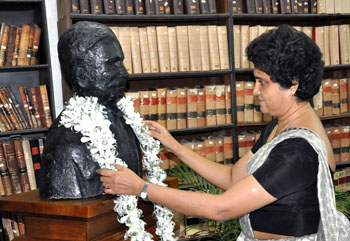
Chief Justice unveiled the bust of late H.L.de Silva - July 27,2011
Having regard to these far reaching powers it appears to be in congruous for Parliament determine a procedure under Article 107(3) by framing Standing Orders that give the power to Select Committee of the House to determine whether or not a judge of the Supreme Court or the Court of Appeal has been guilty of misbehavior or incapacitated, as ground for removal from office. The determination of guilt when a judge is charged with misconduct is clearly an exercise of judicial power by Parliament directly, which is inconsistent with Article 4(c), since it does not fall within the exception therein mentioned. I my submission, what is contemplated in Article 107(3) is prescribing procedure which enables the guilt of a judge to be determined by a body competent to exercise judicial power directly, namely a court, tribunal or other institution established for the purpose. It is only after a judicial finding by such a body that Parliament is empowered under Article 107 to vote on the question of his removal. The existing procedural anomaly needs to be remedied.
(This paragraph is also can found in “IDEAS FOR CONSTITUTIONAL REFORMS” , EDITED BY Dr Chanaka Amaratunga revised and abridged by Dr Rajiva Wijesinha-2007- IBH Publishers at page 239)
*Sent by Kamal Nissanka, Attorney-at-Law, Secretary General, Liberal Party of Sri Lanka
Read more about Impeachment Motion Against Chief Justice Shirani Bandaranayake here

The Unmet Task Of The Political Opposition


By Jehan Perera -
Jehan Perera
The government appears determined to go ahead with the impeachment of theChief Justice.  So far the attempts to broker a mutually acceptable solution have not yielded success. Not even the messages sent by the highest religious dignitaries or their joint statements have had their desired impact.  There have also been civil society initiatives to find a way out of the growing confrontation.  They have sought to convey to the government leadership that it has lost the intelligentsia’s support on the matter of the impeachment and that any good society needs checks and balances as exemplified by an independent judiciary.   But it appears that the peacemaking efforts of civil society groups have also come to naught.
It also seems that the parliamentary members in Sri Lanka, including both government and opposition, are very concerned about the powers and privileges of Parliament and do not want those to be compromised. There is an emphasis on issues of sovereignty of the people and of Parliament.  It is argued that no judicial powers have been entrusted to the Parliamentary Select Committee that is investigating the charges against the Chief Justice, and so the Supreme Court cannot issues notices on them.   There is a focus on the powers of Parliament while there is an even bigger issue that needs to be addressed. This is the fact that the impeachment threatens the effective collapse of judicial independence.  What an impeachment of the Chief Justice will mean to the rest of the judiciary in relation to political interference has to be the greater priority.
The main challenge in society today is to safeguard and strengthen the system of checks and balances to control the abuse of power that comes from having absolute power.  The main political features in Sri Lanka are the ongoing concentration of power in the hands of the government leadership.  This gives an impression of stability, especially when opposition members are constantly joining the government and eating out of its hand. The opposition parties have so far not shown themselves able to mount a challenge to the government.  At this time the opposition parties and civil society are marginal actors.  The opposition is fragmented without much appeal to the people. There is also a culture of fear that keeps people from mobilizing against the government.  There is also co-optation that needs to be struggled against.
Larger Consequences 
As the Burmese opposition leader Aung San Suu Kyi has said, “I think we have to accept the sad fact that people are attracted by power. I have found that perfectly decent [people] are flattered when the ruling governments bathe them with some attention, makes a fuss over them, and this is true for Burmese people as well as for non-Burmese people who come to Burma. And this attraction that power and influence has over humanity in general works against those who are in the dissenting faction because we are who are dissidents, we don’t have the power, and people tend to think that those who are in power must be in power for good reasons when actually there can be very, very horrible reasons for people being in power. So I think what we have to do is to raise people’s awareness as to where it leads to in the long run – if you support those who should not be supported.”
Although the war ended more than three and a half years ago, Sri Lanka has not yet become a stable, democratic country.  The disappearances, abductions and killings that took place during the war time are very much less today.  But there continues to be a large military presence in the North and East, and the military intrudes into civilian life more than is necessary now that there is no more war or militant activity. The increase in the level and brutality of violence, despite the large security presence and sometimes due to it, is an indication that our society has still not healed from the war.  Robberies and thefts have always been a problem.  The real and imagined fear of the White Van is there to reduce the activism of those who are trying to even criticize and reform the government.
It is significant that the violence we see is happening despite a massive investment being made in security and security forces.  The Chief Justice of Pakistan recently made a speech that has relevance to us in Sri Lanka.  He said, “Gone are the days when stability and security of a country was defined in terms of numbers of missiles and tanks as a manifestation of hard power available at the disposal of the state.” Therefore, he said “A heavy responsibility lay upon Supreme Court judges for being the guardians and protectors of the constitution to uphold the canons of the constitution’s predominance and its supremacy over all other institutions and authorities.”  The role of the judiciary in maintaining the integrity of the system of democracy, and its necessary checks and balances, cannot be underestimated.
Unmet Task
So far the Supreme Court appears to be standing firm in upholding its constitutional position. However, the political position of the government in the unequal contest appears to be unassailably strong.  It has a 2/3 majority in Parliament and a popular President heading the executive branch of government.  The even greater strength of the government is its ability to get a substantial majority of people to agree on its course of action.  In terms of using the state and private media, the government voice is much more powerful than any other.  Government leaders, exemplified by President Mahinda Rajapaksa, also have an exceptional ability to put across the government’s point of view in a manner that is comprehensible to the masses of people.
In the absence of a strong opposition that is equally competent at taking its message to the people, it is unlikely that the explanatory powers of either the judiciary or lawyers can match that of the government when it comes to winning the support of the people.  The fact that the Bar Association of Sri Lanka has at last decided to file action before the courts objecting to the manner of the impeachment is an indication of how the larger part of the intelligentsia in the country thinks.  They are deeply concerned about the weakening of the democratic system and its checks and balances.  But they are unlikely to be the ones to win the debate for the hearts and minds of the people.  This is the unmet task of the political opposition.
Whether in Pakistan or Egypt, where powerful governments also took on the judiciary, it was not civic or legal action by themselves that halted those governments.  Those powerful governments were forced to step back by mass movements in which hundreds of thousands of people participated.  Those mass movements were led by opposition political parties, which had both leaders and party machineries that were equal to the task.  However, in Sri Lanka, the political opposition has not mobilized a mass movement of protest against the impeachment.  Instead it seems to be more interested in fine tuning the role of the legislature in relation to the judiciary.  This needs to change and there needs to be a larger vision.  The way is through increasing the level of political awareness of the people.

Saturday, December 1, 2012

No one is above the law: Asgiri Mahanayake

Daily Mirror, 1/12/2012,

Asgiriya Chapter Maha Nayake Thera the Venerable Udugama Sri Buddharakkita Thera yesterday underlined the statement made by the Mahanayake Theras against the impeachment motion on the Chief Justice. He said if there was a law in the country it should be applied equally to all.

Speaking to US ambassador Michele J. Sison who paid a courtesy call on the Prelate, he said some people in the country were accusing others when they could not fulfill their personal agendas.

“There should be an opportunity for those who act in a fair and just manner to carry out their duties without let or hindrance,” he said.

Ms Sison visited the historic Dalada Maligawa and paid homage to the Tooth Relic before her courtesy call on the Mahanayake Thera.

She asked the Thera about a statement on the Impeachment of the Chief Justice and excessive borrowings .made by the Mahanayake Theras. It was published in the English daily newspapers

The Mahanayaka Thera said they had issued the statement to the effect that all were equal before the law of the land, but it had become apparent now that some were using it for their own agendas.

He said when politicians find it difficult to achieve their personal agendas they try to bring disrepute to those who abide by the law.

“It is not fair and therefore we issued a joint statement as the Mahanayaka Theras of the Three Nikayas.

We observed that some were bent on creating a situation to embarrass those who uphold the laws of the country,” the Mahanayke Thera said.

He commended the assistance rendered to Sri Lanka by the US government and extended his blessings and good wishes to President Barack Obama who had been re-elected for a second term.

“The US government has helped our country in the past and does so in the present. We hope it will continue it in the future as well,” he said.

The ambassador responded by saying the US helped Sri Lanka during the tsunami and there exists a cordial relationship between the two countries.
She said the US for its part would continue maintaining the good relationship and added that she appreciated the sentiments expressed by the Mahanayaka Thera.

Ms. Sison also met the Diyawadana Nilame Nilanga Pradeep Dela at the precincts of the Dalada Maligawa.

SC goes ahead with Appeal Court reference Impeachment motion against CJ


*Speaker, PSC members absent
*Registrar directed to inform them of new dates

By Chitra Weerarathne

The Supreme Court yesterday fixed the hearing of the reference from the Court of Appeal for December 13 and 14, 2012 and directed the Registrar of the Court to notify the respondents of the dates fixed for the hearing.

The reference is on the interpretation of Article 107/3 of the Constitution. The respondents are the members of the Parliamentary Select Committee and the Speaker.

An intervention by one Roshan Fernando was refused, since there were no proper documents filed.

The bench comprised Justices N. G. Amaratunga, K. Sripavan and P. Dep.

Article 107(3) refers to the procedure adopted in moving to impeach a Judge of the Court of Appeal. The original Writ Application in the Court of Appeal had requested that Court prohibit the Parliamentary Select Committee from continuing with the inquiry against the Chief Justice.

The reference was made to the Supreme Court by the Court of Appeal during the hearing of some Writ Applications, filed against the Parliamentary Select Committee, appointed to investigate allegations against the Chief Justice Dr. Shirani Bandaranayake.

Fixing December 13 and 14, 2012 as the next dates on which the references would be heard, the Supreme Court directed the Registrar of the Court to notify the respondents of the dates. The Court also said that the Registrar of the Court of Appeal had notified the respondents of the Writ Application by Nov. 28, 2012.

Yesterday the respondents, except the Attorney General, were absent and unrepresented.

The Attorney General Palith Fernando appeared as Amicus Curiae to assist the Court.

The respondents were given time to file written submissions prior to the next date of hearing.

President’s counsel K. Kanag Ishwaran appeared for the petitioner, Chandrapala Jayaratne and a few others.

The Attorney General Palitha Fernando appeared only for himself together with Deputy Solicitor General Sanjay Rajaratnam and a Senior State Counsel, Nevin Pulle.

Professor Suffrullah appeared for Roshan Fernando, who attempted to intervene.

The Supreme Court said that it was acting according to Rule 64(1) of Supreme Court Rules.

Friday, November 30, 2012

November 28 Jaffna: Appalling Attack And Unjustifiable Reactions


Nirmanusan Balasundaram
On the evening of the November 27 at 06:07 PM (local time), flames were lit in commemoration of Maaveerar Naal 2012 (Martyrs’ Day 2012). It was initiated by the Tamil students from the Jaffna University.
Pre-deployed Sri Lankan troops forcibly entered into the Ladies’ Hostel and attacked the students and damaged properties, soon after they realized that the flames were lit inside the Ladies’ Hostel of the Jaffna University. The victims called the University administration to escape from the attack and seek safety. However, following the attack tensions prevailed.
More troops and policemen were deployed to the university vicinity by the Sri Lankan Defense establishment in Jaffna. The next day (November 28), the students called for a nonviolent protest in opposition to the military attack against the students. The sit-in protest which took place within the university premises revisited memories of the Satyagraha campaign led by the late S.J.V.Chelvanayagam.
Vicious Cycle
Just as successive Sri Lankan governments and their hooligan mobs attacked the Gandhian way of the Satyagraha campaigns of 1956 and 1961, on the 28th the Sri Lankan army and policemen unleashed their terror campaign against the university students, who were marching peacefully within university surroundings holding placards, with a considerable number of  students symbolically covering their mouths with black cloths.
The attackers injured about 20 students, damaged the vehicle of a TNA parliamentarian, and harassed and threatened a Tamil journalist trying to cover the incident.
The history of the island indicates that it was the oppression of Tamils’ democratic struggle that led the Tamil youth to take up arms to safeguard their nation’s rights, especially that of freedom.  The outcome of which was known not just to the people of the island, but also the world.  Despite this, the Sri Lankan Armed Forces’ atrocities against the Tamil people continues today, mirroring past acts of violence.
This act of abuse and oppression reveals the importance of demilitarization, as situation of an open prison is prolonged in the NorthEast, particularly in the North.
Failure of the Media
International media outlets justified their failure to aptly cover the genocidal war in late-2008 to mid-2009 by blaming the Sri Lankan government’s denial to independent and international journalists to access/enter the war zone. Yet, today, with no directive war taking place, media coverage by the Colombo based English and Sinhala media of the brutal attack against the Jaffna University students has been extremely poor. While polarization of the national media continues, imbalanced reporting by international media outlets emanated once again.  Jan Jananayagam,  Director, Tamils Against Genocide [TAG] tweeted, “sickening that colombo-based european media like @afp have not learned from their failures in 2009”, highlighting that “misleading account from @afp omits to say students threw stones AFTER military attacked peaceful demo” – a vital omission leading to suggest that it was the students’ act triggered the military’s violent response.
She further tweeted BBC “who failed disgustingly in 2009, reporting from colombo repeats srilankan military lies about jaffna protests” and added that the BBC pretends ‘balanced’ reporting involves quoting of discredited lanka army sources w’out mentioning their previous record of mendacity”.
The BBC reportage also failed to include the students’ version of the story – a vital view of the incident, while having given attention to the Sri Lankan military’s false recount of events.
This misrepresentation by the AFP and BBC only assists the Sri Lankan government’s propaganda machine.
“Save us”
Speaking to the victimized students, a student leader said:
This is a most degrading incident. They [the armed forces] have entered the Ladies’ Hostel. This is an indecent act. So we are protesting against this act by the Sri Lankan Army. The University Administration says they knew nothing about it. We cannot believe this because at that time there was no one around. It was only after the army came and took their positions that the officers from the administration arrived and then simply chose to watch the proceedings.
To what extent are you [the University Administration] protecting the students?  How can this happen without the administration’s knowledge? What is the use of having a Vice-Chancellor? It is better to have an ordinary soldier as a VC then… If an ordinary soldier can come within the university premises and threaten the students, what is the need for you [the VC]? I am not trying to abuse anyone. Please consider this, our VC, our administration – if the army can freely enter the university premises then what need is there for an administration?
Therefore to prevent these kinds of incidents happening, we can’t ask anyone, we are not in a position to ask anyone, we can only show this as a protest, to the international community. There is no one in Jaffna to listen to us, it is only the international community which must open its eyes and save us.
International Response
According to the available information, no prompt statements have been issued by the international community, except for that of the U.S. embassy in Colombo. While describing it as a “peaceful demonstration”, the U.S. embassy said in its statement that it was “greatly concerned about reports of attacks on students in Jaffna”. It further states its concern “about recent threats to freedom of expression in Sri Lanka” with the “November 28 beating of a reporter in Jaffna, harassment by Government of Sri Lanka officials of independent media outlets, and searches without warrants of journalists all..[serving]…to stifle media freedom”.
Reconciliation: Repeating Rhetoric
The Sri Lankan government continues its malicious propaganda in support of its own so-called action plan for reconciliation, while the Tamil people continue to be oppressed in many forms within an open prison. Freedom of Assembly, Freedom of Expression and other democratic rights have been completely denied to the Tamil people.
Not only on Martyrs’ Day, but even choosing to commemorate kith and kin who were killed during the genocidal warfare in May 2009 has also been extremely restricted to the Tamil people. Even if perceived as an enemy, war memories are to be respected, but the Sri Lankan government has engaged in a continuous act of destroying all the Martyrs cemeteries built throughout the NorthEast in memory of more than twenty thousand LTTE cadres.
It is noteworthy at this juncture that academic sources from within the Jaffna University premises have revealed on condition of anonymity to the JDS, “The soldiers were angry that students have somehow commemorated their heroes and lit the commemoration lamp despite many threats and intimidation. Today’s attack was nothing but a violent retaliation on the students for remembering their own sisters and brothers. This simply shows that we don’t have freedom even to cry silently in the NorthEast”.
In a fundamental sense, the reconciliation comes through respect and acknowledgement and not through denial and continuing terror atrocities. Committing massacres and denying the survivors their right to remember is simply an extention of the genocidal policy of the state. Therefore, the international community should act swiftly in order to prevent any further atrocities against the Tamil people in the island, while ensuring their right to peaceful assembly and protest.

Stop The Impeachment Motion Against The CJ: An Online Petition Launched


By Colombo Telegraph - 29/11/2012
A group called ‘Coalition for judicial Independence’ launched an online petition against the Impeachment motion.
We below publish the full text of the petition;
We request the Sri Lankan president and government to withdraw the false Impeachment motion against the Chief Justice.
Chief Justice
A notice of an impeachment resolution signed by approximately 117 Hon members of parliament has been handed over to Hon the speakers, against the Hon Chief Justice of Sri Lanka.
Prior to this, there were a number of orders that had been delivered by the Supreme Court Presided by Hon the Chief Justice which may not have been to the liking of the Executive and/or the ruling party, culminating in the handing over of such resolution.
The Sovereignty of the people under the constitution of the democratic socialist republic of Sri Lanka in exercised and enjoyed, inter alia by;
a) Parliament consisting of elected representative of the people exercising legislative power,
b) His Excellency the president of the republic elected by the people exercising executive power, and
c) Court tribunals and institutions created and established or recognized by the constitution or judicial power of the people.
Thus you would see that there is, inter alia, separation of power between the executive legislature and the Judiciary, in order to ensure good governance.
We would also wish to place on reword that the standing orders (No 78A) which was brought into operation in the year 1984 does not seen to ensure a fair trial/ inquiry according to the accepted principles relating to four trial/inquiry to a person thought before a selected committee and it required a drastic amendment to the said provisions, if it is to ensure such a four trial/inquiry.
Further, an impeachment of Hon the Chief Justice at this stage, in the aforesaid backgrounds may have a negative effect on the independence of the Judiciary. This would well have a serious effect on the right of the citizens of this country.
In the aforesaid circumstances, we call upon you to sign with this e- petition to persuading the impeachment concerned to refrain from pursuing the impeachment motion.
Yours Faithfully
Coalition for judicial Independence
To Sign Click  here

Midweek Politics: Towards Constitutional Deadlock


Dharisha Bastians
Sweeping changes are taking place on Reid Avenue, Colombo. A shiny white colonial building looks set to be the city’s next favourite shopping precinct and hangout. A twin construction is being erected adjacently. As the Urban Development Authority under the purview of the Ministry of Defence continues beautifying the capital city, large and ancient trees that in living memory have always lined the street, are being felled to make way for paved walkways and cycle lanes.
The heartbreaking sight of enormous trees stumps soon to be removed by backhoes and large leafy branches piled up on the side of the road have sparked outrage amongst naturalists and in the tree-hugger community, but none of this is likely to deter the authorities. The tree-felling occurred suddenly and without warning – much like the other business of this Government – and those shade-givers will soon be relegated to being just another victim in the country’s march towards development. Like the weeping willow trees that lined Independence Avenue. Like the shanty dwellings that were razed in Slave Island and elsewhere, turning hundreds of people out of their homes overnight.
In so many ways, the arbitrary decisions to destroy the city’s green landmarks are symptomatic of an entirely different problem. The ruling administration is enjoying the perks of absolute power, in the face of a helpless citizenry, in the face of an increasingly apathetic and impotent opposition. Just ask the beleaguered Chief Justice, Shirani Bandaranayake.
CJ before PSC
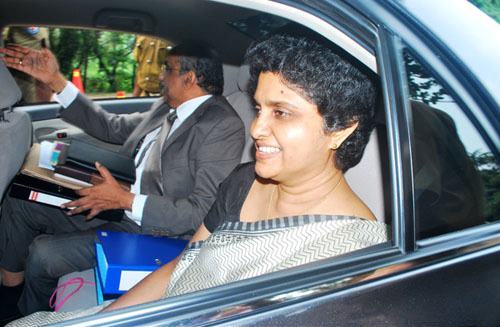
Last Friday morning (23) clad in a simple white and black sari, Chief Justice Bandaranayake left the Superior Court complex at Hulftsdorp to appear before the Parliamentary Select Committee investigating the impeachment motion against her. The iconic scenes that greeted the Chief Justice on her way out of the courts struck a chord with the general public, not only because Bandaranayake is a seemingly innocent victim in a high-handed move by the incumbent regime – but because she is also a woman.
She elicited natural sympathy and responded to it with dignity, clasping the hands of junior lawyers who were visibly emotional outside the court house on Friday. At the entrance to Parliament, the Chief Justice also rolled down her car window, giving patiently waiting photojournalists a chance to click a few shots before she proceeded to answer her summons before the committee.
But before the Chief Justice could be granted an audience, the committee had matters pending before it. The previous afternoon, on Thursday (22) Supreme Court Justices Gamini Amaratunge, J. Sripavan and Priyasath Dep had issued an order having heard submissions from petitioners regarding the constitutionality of the PSC process to hear the impeachment.
The Supreme Court bench, in a cautiously worded order referring to the cooperation that should exist between different branches of Government – in this case the Legislature and the Judiciary – requested the 11 members of the PSC to stay proceedings and postpone their investigation into the motion of impeachment against Chief Justice Bandaranayake until after the Court had provided its interpretation of Articles 107 (2) and (3) of the Constitution in respect of Articles 3 and 4 (c).
The Supreme Court order (or recommendation) was being prepared late into the evening by the Court Registrar and was eventually couriered by special messenger to each of the respondents cited in the petitions pending before the court, including the 11 members of the PSC and the Speaker of Parliament the night before the Chief Justice was to answer her summons.
Dismissing SC recommendation
So the first order of business before the PSC on Friday morning was to determine whether or not it would abide by the Supreme Court’s request. While Select Committee proceedings are secret and a matter of privilege, the fact that Chief Justice Bandaranayake appeared before the Committee for nearly two hours later that day, meant that the Committee had decided to ignore the Supreme Court’s recommendation and proceed as scheduled. It is now learnt that the Committee’s opposition members put up stiff resistance to continuing with the proceedings in light of the Court recommendation.
Other information regarding the conduct of certain members of the PSC have come to light following Friday’s proceedings but cannot be made public under the rules of Parliamentary privilege. However several online publications that remain immune to privilege restrictions have made the information public. This includes the full text of the reply drafted by the Chief Justice’s lawyers to the 14 charges contained in the impeachment motion, that range from financial misconduct to conflict of interest issues, perceptions of bias and harassment of junior judges. Interestingly, the response from the Chief Justice’s lawyers also challenges the jurisdiction of the PSC because it amounts to an exercise of judicial power, vested with the courts of law.
The Chief Justice was kept waiting for about 45 minutes past the appointed time and then requested to enter Committee Room One where the Committee was sitting, without her lawyers. When she refused, the committee allowed her to bring the head of her legal team, President’s Counsel Romesh De Silva into the room with her. Subsequently, the other five members of her legal team were permitted entry. It bears mentioning that in the historic case, Chief Justice Bandaranayake is being represented by one of the country’s best legal minds, Romesh De Silva, PC and supported by Nalin Ladduwahetty, PC, and Attorneys at Law Saliya Peiris, Riyad Ameen, Sugath Caldera, and Eraj de Silva.
The legal team is being instructed by Neelakandan and Neelakandan attorneys at law, a highly respected legal firm established 50 years ago. Senior lawyers point out that it also bears noting that in a real court of law, the error-ridden impeachment motion would be summarily dismissed. Instead, the Committee has refused the Chief Justice the six weeks time her legal team requested to fully prepare her defence against the charges mounted against her and gave her instead one week – until 30 November to file additional submissions. The PSC will convene again on 4 December.
Unceasing litigation
Meanwhile, an unceasing wave of litigation is being filed at the Court of Appeal and the Supreme Court challenging the legality of the impeachment process. Several of the petitions challenge the constitutionality of the Legislative committee set up to probe the impeachment because according to Article 4 (c) of the Constitution, judicial power is vested with the courts and according to Article 3 of the Constitution, sovereign power thus vested is inalienable or cannot be transferred and is protected by the supreme law of the land.
Adding to the list of litigants and amidst fire about its relative inaction about the efforts to remove the country’s top judge, the Bar Association of Sri Lanka on Monday (26) filed a fundamental rights petition against the impeachment. The case was filed by BASL President and MP Wijedasa Rajapakse and three others and cites that the impeachment motion against the Chief Justice violated their fundamental rights since it may have an impact on the Judiciary decisions on the Government and the entire judicial system. The petitioners have also cited the presence of bias in the Parliamentary Select Committee process that probes the 14 counts of charges against the Chief Justice.
According to informed sources, the Bar is also mulling bringing charges of contempt against members of the PSC who are also attorneys-at-law and seeking their disbarment for disrespecting the dictates of the Supreme Court. Seven out of 11 members of the PSC are attorneys.
On Friday, concurrent to PSC proceedings in Parliament the Supreme Court bench comprising Justices Amaratunga, Sripavan and Dep gave leave to proceed in three Fundamental Rights petitions. While hearing submissions, Justice Amaratunga took a firm line with Deputy Solicitor General Shavindra Fernando, asking him to read out Standing Order 78A and Article 4 (c) of the Constitution, before disagreeing with him that 78A pertained to the business of Parliament and could not be encroached upon.
The fundamental argument being made by petitioners, many of whom are being represented by some of the country’s most erudite legal practitioners, is that (a) Article 4 (c) of the Constitution vests the judicial power of the people in the courts of law, (b) that Article 3 of the Constitution implies that these powers thus vested cannot be transferred and (c) Standing Order 78A is not a law and cannot therefore seek to accrue judicial power to a legislative committee and that such empowerment violates Article 4 (c) of the Constitution. The power to examine evidence and rule on guilt and innocence is the exercise of judicial power, several lawyers for the petitioners argue.
In their written submissions to the Supreme Court, to which court a writ of prohibition filed by Chandra Jayaratne in the Court of Appeal was referred for Constitutional interpretation, lawyers for the petitioner led by K. Kanag-Iswaran PC, argue that framers of the Constitution could not have envisioned or intended for Parliament to be the accuser, judge and executioner in the process of removing a justice of the superior courts.
President’s Counsel Kanag-Iswaran in his submissions also refers to the process for the removal of a President of the republic in which the Constitution makes abundantly clear that the process for investigation, hearing evidence and pronouncement of guilt or innocence is undertaken by the Supreme Court, an established judicial body.
The trouble with ’78
Considering the Constitutional quagmire Sri Lanka finds itself in today, there is a widespread perception that the 1978 Constitution has not gone into adequate detail with regard to the process that needs to be undertaken to remove a judge of the superior courts. On the other hand, the framers of the ’78 Constitution offer more clarity on the process to impeach the President, naturally because that process would have been of particular interest to Sri Lanka’s first Executive President, J.R. Jayewardene.
For instance, 1978 calls for only an absolute majority of 113 members to vote on the impeachment of a judge, while the impeachment of the President requires a two thirds majority in the House, a difficult ask under any circumstances preceding the crossover ruling provided by former Chief Justice Sarath N. Silva. Safeguards are therefore in place to make the impeachment of a president incredibly difficult, but the Constitution does not offer the same protection for a judge of the superior courts due to a lack of clarity in the provisions pertaining to process for the removal of a judge as set out in Article 107 (2) and (3). Under the circumstances, a judge of the superior court against whom a motion of impeachment is moved, has no redress outside the Parliament mechanism set up by Standing Order 78A which was hastily adopted in 1984.
Legal experts are arguing that the PSC set up by 78A goes against all laws of natural justice, because the majority in the committee is held by members of the Government that brought the motion of impeachment against the Chief Justice. Under the circumstances, it is virtually impossible to believe that the Chief Justice will be given a fair trial, the right of every citizen of the Republic of Sri Lanka.
As Kanag-Iswaran points out in his written submission to the Supreme Court, Article 38 (2) of the Constitution provides for a judicial undertaking on the charges levelled in an impeachment motion against the President by the Supreme Court, once a resolution of impeachment is passed by two thirds of the members of the House. The President or his legal representative has the right to appear and be heard before the Supreme Court after which the Court reports its determination to Parliament. If the Supreme Court finds the president guilty of the charges levelled or incapable of functioning in the office, the resolution must be passed once again by a two thirds majority of the House.
The phrasing of the provisions relating to presidential impeachment, some lawyers argue, imply that if Supreme Court returns the determination of not-guilty, the impeachment matter ends there. The most important point, in terms of the challenges to the impeachment process against the Chief Justice is that the charges are judicially examined in the case of a presidential impeachment, by a legitimately constituted court of law.
Deadlock imminent?
Under the circumstances, in their order issued on Thursday, recommending the stay on PSC proceedings, the Supreme Court’s exercise of restraint was particularly important. Had the Justices issued a stay order on the PSC instead, it would have propelled the Judiciary and the Legislature headlong into a constitutional deadlock that resulted in the proroguing of Parliament after a similar ruling by the Highest Court in 2001 was challenged and overruled by Speaker Anura Bandaranaike.
Furthermore, noises emanating from opposition quarters make it clear that in the event that the Supreme Court attempts to stay the business of Parliament, the UNP led by its Leader Ranil Wickremesinghe will fully back the Government to assert Parliament’s supremacy over the courts. Therefore many activists for the Chief Justice’s cause, say such a move could prove devastating in the larger scheme of things.
In any case, bearing in mind the necessity to keep all organs of the state functioning harmoniously, the Bench decided to go the gentler route, of making a civilised request of legislators in the PSC who are all bound by an oath to uphold the Constitution of Sri Lanka. Government legislators are warning the Supreme Court to refrain from challenging the Parliament’s supremacy over the courts, but legal analysts point to the provisions to impeach the President as testament that the Constitution’s framers did not believe that Parliament was beyond judicial reach when it pertains to the exercise of judicial power – inquiry, examination of evidence and pronouncement of guilt, etc.
The fact that Supreme Court must deliver a guilty verdict in order for Parliament to proceed with impeaching a president, means that in judicial matters the Legislature must submit to the Judiciary, although this is not to say that either organ of the State is supreme to the other, but that the Constitution clearly vests specific powers with specific branches of the State and those powers are simply non-transferrable.
But even as legal challenges to the impeachment mount, legal experts are warning of an impending Constitutional deadlock with the Government determined to steamroll their way through this impeachment process, irrespective of how the courts of law feel about it.
In fact the regime is intent on going through with the process irrespective of the feelings of much of its House membership which is opposed to the impeachment against the Chief Justice. Several SLFP seniors are deeply perturbed by the Government’s intent to forge ahead amidst mounting domestic and international pressure that is bound to be deeply damaging to the Sri Lankan State in the long run.
On the eve of the Chief Justice’s appearance before the PSC, a senior President’s Counsel reportedly met the Chief Justice to offer her ‘all support’. The senior lawyer is the father of a Deputy Minister in the UPFA Government, also a lawyer, who is playing a role in the impeachment process on behalf of the Government.
The website Colombo Telegraph reports that this senior lawyer visited Chief Justice Bandaranayake at 11 a.m. on Thursday (22). His son is reportedly perturbed about the perception that he has a hand in the impeachment process. Interestingly, when the UNP brought a motion of impeachment against Chief JusticeSarath N. Silva, the senior lawyer in question along with three other lawyers petitioned the Supreme Court on behalf of the Chandrika Kumaratunga led People’s Alliance for a stay order against Anura Bandaranaikeappointing a select committee to probe the motion. The stay order was granted by the Court but overruled by Speaker Bandaranaike.
Opposition to impeachment
Forces against the impeachment continue to gather. Yesterday the Chief Prelates of the three main Buddhist monastic orders issued a second letter to President Mahinda Rajapaksa urging him to stay the impeachment process. The Chief Prelates issued a similar missive to the President several weeks ago which has gone largely ignored, other than for a cursory response to the chief monks, saying “attention had been drawn to the contents of their letter.”
“The majority of the people think that the impeachment motion against the Chief Justice will lead to disenchantment about all branches of the Judiciary. Therefore the Government should think patiently about the ill-effect of the prevailing attempt of the Legislature, Executive and the Judiciary to go above the other and take steps to safeguard the independence of the Judiciary and solidify the feelings of justice in the minds of the people. By the display of just behaviour of the Government it will definitely generate a feeling of satisfaction in the minds of the people. It is possible to get humans to respect law and traditions by acting according to human ethics without scorn. Therefore to avoid the breakdown in law and deterioration of society as a result of the impeachment motion we kindly request that the impeachment motion be withdrawn, taking into consideration the recent recommendation of the Supreme Court. This will be beneficial to the country,” the prelates said in their letter to the President.
Former UNP Deputy Leader and MP Karu Jayasuriya is believed to have been instrumental in spurring the prelates into action once more, even as the impeachment saga intensifies. Jayasuriya enjoys significant support from the country’s clergy, having maintained a pluralist political outlook whilst maintaining his ties to Buddhism according to which philosophy the senior politician says he tries to live his life.
Steamrolling
Having swept to power on the back of support by the Sinhala Buddhist majority and commanding the alliance of right wingers within its coalition, one would think that the appeals from the monks would sway the Rajapaksa Administration somewhat. But when it comes to this impeachment process, the Government prefers to be done with it as soon as possible and no matter how many obstacles stand in their way, whether they don saffron robes or not.
Government insiders and Opposition Parliamentarians claim that the verdict on the motion of impeachment is already being drafted by senior Government Ministers and former AGs based on the Chief Justice’s reply to the charges and the administration is intent on concluding PSC proceedings by 8 December if possible.
In every respect however, even the ruling regime realises it may have bitten off more than it can chew. According to senior UPFA sources, the Government was certain that the pressure brought to bear upon her by the impeachment motion would force Chief Justice Bandaranayake to step down, clearing the way for the appointment of a CJ more to the regime’s taste. Her decision to fight the impeachment and the frivolity of the charges contained in the tabled resolution however, have posed a conundrum for the regime which cannot backtrack on its bid to impeach Bandaranayake, but also faces serious issues of de-legitimacy if the flawed process goes through.
Even if Chief Justice Bandaranayake loses this battle, and that is the likely outcome, she will go down in history as being a person who stood up to the Executive and refused to go out without a fight. Either way, Friday’s iconic scenes as the Chief Justice made her way to Parliament to face her accusers proved that the net result of the Government’s move to remove the country’s top judge was something they never wanted. It has turned Dr. Shirani Bandaranayake, Sri Lanka’s first female Chief Justice, into an unlikely heroine.
Courtesy Daily FT